


Page 309 - First Aid for the USMLE Step 1 2020, Thirtieth edition [MedicalBooksVN.com]_Neat
P. 309
Public HealtH ScienceS ` PUBLIC HEALTH SCIENCES—EPIdEmIoLogy ANd BIoSTATISTICS Public HealtH ScienceS ` PUBLIC HEALTH SCIENCES—ETHICS SectiOn ii 265
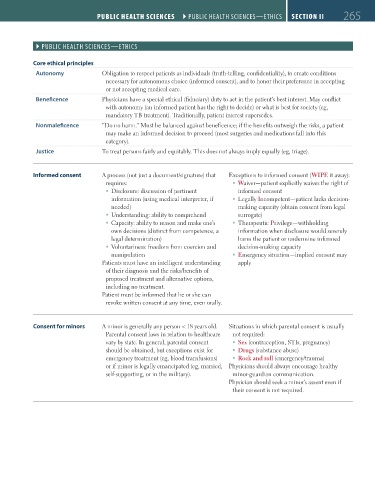
` PUBLIC HEALTH SCIENCES—ETHICS
Core ethical principles
Autonomy Obligation to respect patients as individuals (truth-telling, confidentiality), to create conditions
necessary for autonomous choice (informed consent), and to honor their preference in accepting
or not accepting medical care.
Beneficence Physicians have a special ethical (fiduciary) duty to act in the patient’s best interest. May conflict
with autonomy (an informed patient has the right to decide) or what is best for society (eg,
mandatory TB treatment). Traditionally, patient interest supersedes.
Nonmaleficence “Do no harm.” Must be balanced against beneficence; if the benefits outweigh the risks, a patient
may make an informed decision to proceed (most surgeries and medications fall into this
category).
Justice To treat persons fairly and equitably. This does not always imply equally (eg, triage).
Informed consent A process (not just a document/signature) that Exceptions to informed consent (WIPE it away):
requires: Waiver—patient explicitly waives the right of
Disclosure: discussion of pertinent informed consent
information (using medical interpreter, if Legally Incompetent—patient lacks decision-
needed) making capacity (obtain consent from legal
Understanding: ability to comprehend surrogate)
Capacity: ability to reason and make one’s Therapeutic Privilege—withholding
own decisions (distinct from competence, a information when disclosure would severely
legal determination) harm the patient or undermine informed
Voluntariness: freedom from coercion and decision-making capacity
manipulation Emergency situation—implied consent may
Patients must have an intelligent understanding apply
of their diagnosis and the risks/benefits of
proposed treatment and alternative options,
including no treatment.
Patient must be informed that he or she can
revoke written consent at any time, even orally.
Consent for minors A minor is generally any person < 18 years old. Situations in which parental consent is usually
Parental consent laws in relation to healthcare not required:
vary by state. In general, parental consent Sex (contraception, STIs, pregnancy)
should be obtained, but exceptions exist for Drugs (substance abuse)
emergency treatment (eg, blood transfusions) Rock and roll (emergency/trauma)
or if minor is legally emancipated (eg, married, Physicians should always encourage healthy
self-supporting, or in the military). minor-guardian communication.
Physician should seek a minor’s assent even if
their consent is not required.
FAS1_2019_06-PubHealth.indd 265 11/7/19 4:16 PM

