


Page 34 - First Aid for the USMLE Step 1 2020, Thirtieth edition [MedicalBooksVN.com]_Neat
P. 34
Guide to efficient exam PreParation                       Guide to efficient exam PreParation         Section i          11


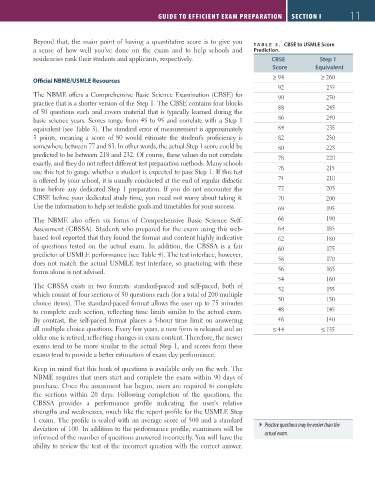
                  Beyond that, the main point of having a quantitative score is to give you   T ABLE 3.   CBSE to USMLE Score
                  a sense of how well you’ve done on the exam and to help schools and     Prediction.
                  residencies rank their students and applicants, respectively.                 CBSE            Step 1
                                                                                                 Score         Equivalent
                                                                                                 ≥ 94           ≥ 260
                  Official NBME/USMLE Resources
                                                                                                    92             255
                  The NBME offers a Comprehensive Basic Science Examination (CBSE) for              90             250
                  practice that is a shorter version of the Step 1. The CBSE contains four blocks      88          245
                  of 50 questions each and covers material that is typically learned during the
                  basic science years. Scores range from 45 to 95 and correlate with a Step 1       86             240
                  equivalent (see Table 3). The standard error of measurement is approximately      84             235
                  3  points,  meaning  a  score  of  80  would  estimate  the  student’s  proficiency  is      82     230
                  somewhere between 77 and 83. In other words, the actual Step 1 score could be      80            225
                  predicted to be between 218 and 232. Of course, these values do not correlate      78            220
                  exactly, and they do not reflect different test preparation methods. Many schools      76        215
                  use this test to gauge whether a student is expected to pass Step 1. If this test
                  is offered by your school, it is usually conducted at the end of regular didactic      74        210
                  time before any dedicated Step 1 preparation. If you do not encounter the         72             205
                  CBSE before your dedicated study time, you need not worry about taking it.        70             200
                  Use the information to help set realistic goals and timetables for your success.      68         195

                  The NBME also offers six forms of Comprehensive Basic Science Self-               66             190
                  Assessment (CBSSA). Students who prepared for the exam using this web-            64             185
                  based tool reported that they found the format and content highly indicative      62             180
                  of questions tested on the actual exam. In addition, the CBSSA is a fair          60             175
                  predictor of USMLE performance (see Table 4). The test interface, however,        58             170
                  does not match the actual USMLE test interface, so practicing with these
                  forms alone is not advised.                                                       56             165
                                                                                                    54             160
                  The  CBSSA exists in  two  formats: standard-paced and  self-paced,  both of      52             155
                  which consist of four sections of 50 questions each (for a total of 200 multiple      50         150
                  choice items). The standard-paced format allows the user up to 75 minutes
                  to complete each section, reflecting time limits similar to the actual exam.      48             145
                  By contrast, the self-paced format places a 5-hour time limit on answering        46             140
                  all multiple choice questions. Every few years, a new form is released and an   ≤ 44           ≤ 135
                  older one is retired, reflecting changes in exam content. Therefore, the newer
                  exams tend to be more similar to the actual Step 1, and scores from these
                  exams tend to provide a better estimation of exam day performance.
                  Keep in mind that this bank of questions is available only on the web. The
                  NBME requires that users start and complete the exam within 90 days of
                  purchase. Once the assessment has begun, users are required to complete
                  the sections within 20 days. Following completion of the questions, the
                  CBSSA provides a performance profile indicating the user’s relative
                  strengths and weaknesses, much like the report profile for the USMLE Step
                  1 exam. The profile is scaled with an average score of 500 and a standard     ` Practice questions may be easier than the
                  deviation of 100. In addition to the performance profile, examinees will be   actual exam.
                  informed of the number of questions answered incorrectly. You will have the
                  ability to review the text of the incorrect question with the correct answer.


          FAS1_2019_00_Section_I.indd   11                                                                              11/7/19   2:48 PM

