


Page 35 - First Aid for the USMLE Step 1 2020, Thirtieth edition [MedicalBooksVN.com]_Neat
P. 35
12           Section i    Guide to efficient exam PreParation                                                                                                             Guide to efficient exam PreParation


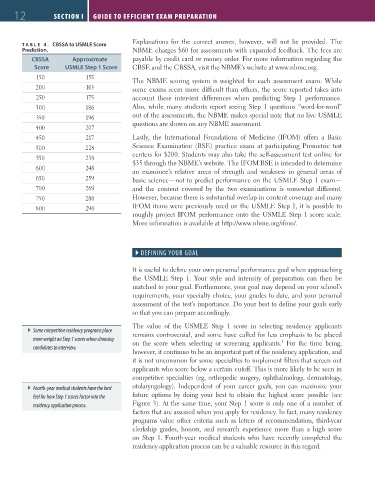
                                                   Explanations  for  the  correct  answer,  however,  will  not  be  provided.  The
               T ABLE 4.   CBSSA to USMLE Score
               Prediction.                         NBME charges $60 for assessments with expanded feedback. The fees are
                  CBSSA        Approximate         payable by credit card or money order. For more information regarding the
                   Score     USMLE Step 1 Score    CBSE and the CBSSA, visit the NBME’s website at www.nbme.org.
                   150              155
                                                   The NBME scoring system is weighted for each assessment exam. While
                   200              165            some exams seem more difficult than others, the score reported takes into
                   250              175            account these inter-test differences when predicting Step 1 performance.
                   300             186             Also, while many students report seeing Step 1 questions “word-for-word”
                   350             196             out of the assessments, the NBME makes special note that no live USMLE
                                                   questions are shown on any NBME assessment.
                   400             207
                   450              217            Lastly, the International Foundations of Medicine (IFOM) offers a Basic

                   500             228             Science Examination (BSE) practice exam at participating Prometric test
                                                   centers for $200. Students may also take the self-assessment test online for
                   550             238
                                                   $35 through the NBME’s website. The IFOM BSE is intended to determine
                   600             248
                                                   an examinee’s relative areas of strength and weakness in general areas of
                   650             259             basic science—not to predict performance on the USMLE Step 1 exam—
                   700             269             and the content covered by the two examinations is somewhat different.
                   750             280             However, because there is substantial overlap in content coverage and many
                   800             290             IFOM items were previously used on the USMLE Step 1, it is possible to
                                                   roughly project IFOM performance onto the USMLE Step 1 score scale.
                                                   More information is available at http://www.nbme.org/ifom/.


                                                    ` `DEFINING YOUR GOAL

                                                   It is useful to define your own personal performance goal when approaching
                                                   the USMLE Step 1. Your style and intensity of preparation can then be
                                                   matched to your goal. Furthermore, your goal may depend on your school’s
                                                   requirements, your specialty choice, your grades to date, and your personal
                                                   assessment of the test’s importance. Do your best to define your goals early
                                                   so that you can prepare accordingly.

                                                   The value of the USMLE Step 1 score in selecting residency applicants
                    ` Some competitive residency programs place   remains controversial, and some have called for less emphasis to be placed
                  more weight on Step 1 scores when choosing   on the score when selecting or screening applicants.  For the time being,
                                                                                                   3
                  candidates to interview.
                                                   however, it continues to be an important part of the residency application, and
                                                   it is not uncommon for some specialties to implement filters that screen out
                                                   applicants who score below a certain cutoff. This is more likely to be seen in
                                                   competitive specialties (eg, orthopedic surgery, ophthalmology, dermatology,
                    ` Fourth-year medical students have the best   otolaryngology). Independent of your career goals, you can maximize your
                  feel for how Step 1 scores factor into the   future  options  by  doing  your  best  to  obtain the  highest  score  possible  (see
                  residency application process.   Figure 3). At the same time, your Step 1 score is only one of a number of
                                                   factors that are assessed when you apply for residency. In fact, many residency
                                                   programs value other criteria such as letters of recommendation, third-year
                                                   clerkship grades, honors, and research experience more than a high score
                                                   on Step 1. Fourth-year medical students who have recently completed the
                                                   residency application process can be a valuable resource in this regard.


          FAS1_2019_00_Section_I.indd   12                                                                              11/7/19   2:48 PM

