


Page 37 - First Aid for the USMLE Step 1 2020, Thirtieth edition [MedicalBooksVN.com]_Neat
P. 37
14           Section i    Guide to efficient exam PreParation                                                                                                             Guide to efficient exam PreParation


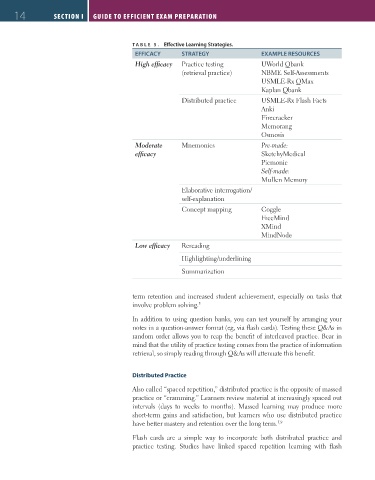
                                                   T ABLE 5.    Effective Learning Strategies.
                                                    EFFICACY       STRATEGY                  EXAMPLE RESOURCES
                                                    High efficacy  Practice testing          UWorld Qbank
                                                                   (retrieval practice)      NBME Self-Assessments
                                                                                             USMLE-Rx QMax
                                                                                             Kaplan Qbank
                                                                   Distributed practice      USMLE-Rx Flash Facts
                                                                                             Anki
                                                                                             Firecracker
                                                                                             Memorang
                                                                                             Osmosis
                                                    Moderate       Mnemonics                 Pre-made:
                                                    efficacy                                 SketchyMedical
                                                                                             Picmonic
                                                                                             Self-made:
                                                                                             Mullen Memory
                                                                   Elaborative interrogation/
                                                                   self-explanation
                                                                   Concept mapping           Coggle
                                                                                             FreeMind
                                                                                             XMind
                                                                                             MindNode
                                                    Low efficacy   Rereading

                                                                   Highlighting/underlining

                                                                   Summarization


                                                   term retention and increased student achievement, especially on tasks that
                                                   involve problem solving.
                                                                        5
                                                   In addition to using question banks, you can test yourself by arranging your
                                                   notes in a question-answer format (eg, via flash cards). Testing these Q&As in
                                                   random order allows you to reap the benefit of interleaved practice. Bear in
                                                   mind that the utility of practice testing comes from the practice of information
                                                   retrieval, so simply reading through Q&As will attenuate this benefit.


                                                   Distributed Practice

                                                   Also called “spaced repetition,” distributed practice is the opposite of massed
                                                   practice or “cramming.” Learners review material at increasingly spaced out
                                                   intervals (days to weeks to months). Massed learning may produce more
                                                   short-term gains and satisfaction, but learners who use distributed practice
                                                   have better mastery and retention over the long term. 5,9
                                                   Flash  cards  are  a  simple  way  to  incorporate  both  distributed  practice  and
                                                   practice testing. Studies have linked spaced repetition learning with flash


          FAS1_2019_00_Section_I.indd   14                                                                              11/7/19   2:48 PM

