


Page 36 - First Aid for the USMLE Step 1 2020, Thirtieth edition [MedicalBooksVN.com]_Neat
P. 36
Guide to efficient exam PreParation                       Guide to efficient exam PreParation         Section i          13


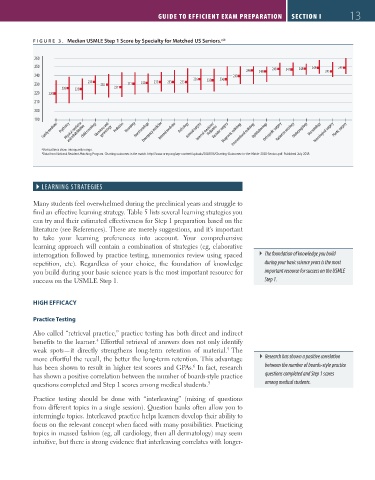
                  FIGURE 3.   Median USMLE Step 1 Score by Specialty for Matched US Seniors. a,b

                   260
                   250                                                                                       249      249
                                                                                        246  245  248  247  248   245
                   240                                                 236     236  240
                   230              233  230     231  232  233  233  233   235
                            226  225         227
                   220  220
                   210
                   200
                   190
                                                      Emergency medicine
                                                                                                              Neurological surgery
                                                                                    Interventional radiology
                      Family medicine  Psychiatry Physical medicine Child neurology Obstetrics and  Pediatrics  Neurology Anesthesiology  Internal medicine  Pathology General surgery Internal medicine/ Vascular surgery Diagnostic radiology   Ophthalmology Orthopedic surgery Radiation oncology Otolaryngology  Dermatology  Plastic surgery
                              and rehabilitation
                                         gynecology
                                                                            Pediatrics
                     a Vertical lines show  interquartile range.
                     b Data from National Resident Matching Program. Charting outcomes in the match. http://www.nrmp.org/wp-content/uploads/2018/06/Charting-Outcomes-in-the-Match-2018-Seniors.pdf. Published July 2018.


                   ` `LEARNING STRATEGIES


                  Many students feel overwhelmed during the preclinical years and struggle to
                  find an effective learning strategy. Table 5 lists several learning strategies you
                  can try and their estimated effectiveness for Step 1 preparation based on the
                  literature (see References). These are merely suggestions, and it’s important
                  to take your learning preferences into account. Your comprehensive
                  learning approach will contain a combination of strategies (eg, elaborative
                  interrogation followed by practice testing, mnemonics review using spaced     ` The foundation of knowledge you build
                  repetition,  etc).  Regardless  of  your  choice,  the  foundation  of  knowledge   during your basic science years is the most
                  you build during your basic science years is the most important resource for   important resource for success on the USMLE
                  success on the USMLE Step 1.                                                Step 1.


                  HIGH EFFICACY

                  Practice Testing

                  Also called “retrieval practice,” practice testing has both direct and indirect
                  benefits to the learner.  Effortful retrieval of answers does not only identify
                                       4
                  weak spots—it directly strengthens long-term retention of material. The
                                                                                  5
                  more effortful the recall, the better the long-term retention. This advantage     ` Research has shown a positive correlation
                  has been shown to result in higher test scores and GPAs.  In fact, research   between the number of boards-style practice
                                                                       6
                  has shown a positive correlation between the number of boards-style practice   questions completed and Step 1 scores
                  questions completed and Step 1 scores among medical students. 7             among medical students.
                  Practice testing should  be done with “interleaving” (mixing of  questions
                  from different topics in a single session). Question banks often allow you to
                  intermingle topics. Interleaved practice helps learners develop their ability to
                  focus on the relevant concept when faced with many possibilities. Practicing
                  topics in massed fashion (eg, all cardiology, then all dermatology) may seem
                  intuitive, but there is strong evidence that interleaving correlates with longer-


          FAS1_2019_00_Section_I.indd   13                                                                              11/7/19   2:48 PM

