


Page 421 - First Aid for the USMLE Step 1 2020, Thirtieth edition [MedicalBooksVN.com]_Neat
P. 421
Gastrointestinal ` gastrointestinal—PatHology Gastrointestinal ` gastrointestinal—PatHology seCtion iii 377
Esophageal pathologies
Diffuse esophageal Spontaneous, nonperistaltic (uncoordinated) contractions of the esophagus with normal LES
spasm pressure. Presents with dysphagia and angina-like chest pain. Barium swallow reveals “corkscrew”
esophagus. Manometry is diagnostic. Treatment includes nitrates and CCBs.
Eosinophilic Infiltration of eosinophils in the esophagus often in atopic patients. Food allergens dysphagia,
esophagitis food impaction. Esophageal rings and linear furrows often seen on endoscopy. Typically
unresponsive to GERD therapy.
Esophageal Most commonly iatrogenic following esophageal instrumentation. Noniatrogenic causes include
perforation spontaneous rupture, foreign body ingestion, trauma, malignancy.
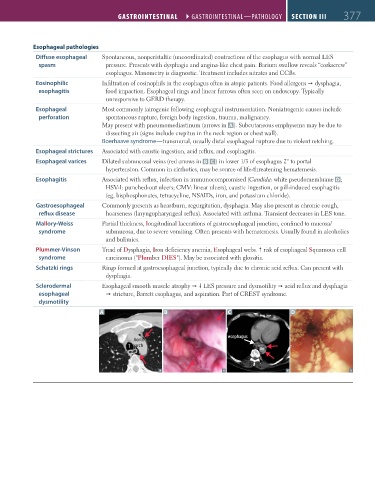
May present with pneumomediastinum (arrows in A ). Subcutaneous emphysema may be due to
dissecting air (signs include crepitus in the neck region or chest wall).
Boerhaave syndrome—transmural, usually distal esophageal rupture due to violent retching.
Esophageal strictures Associated with caustic ingestion, acid reflux, and esophagitis.
Esophageal varices Dilated submucosal veins (red arrows in B C ) in lower 1/3 of esophagus 2° to portal
hypertension. Common in cirrhotics, may be source of life-threatening hematemesis.
Esophagitis Associated with reflux, infection in immunocompromised (Candida: white pseudomembrane D;
HSV-1: punched-out ulcers; CMV: linear ulcers), caustic ingestion, or pill-induced esophagitis
(eg, bisphosphonates, tetracycline, NSAIDs, iron, and potassium chloride).
Gastroesophageal Commonly presents as heartburn, regurgitation, dysphagia. May also present as chronic cough,
reflux disease hoarseness (laryngopharyngeal reflux). Associated with asthma. Transient decreases in LES tone.
Mallory-Weiss Partial thickness, longitudinal lacerations of gastroesophageal junction, confined to mucosa/
syndrome submucosa, due to severe vomiting. Often presents with hematemesis. Usually found in alcoholics
and bulimics.
Plummer-Vinson Triad of Dysphagia, Iron deficiency anemia, Esophageal webs. risk of esophageal Squamous cell
syndrome carcinoma ("Plumber DIES"). May be associated with glossitis.
Schatzki rings Rings formed at gastroesophageal junction, typically due to chronic acid reflux. Can present with
dysphagia.
Sclerodermal Esophageal smooth muscle atrophy LES pressure and dysmotility acid reflux and dysphagia
esophageal stricture, Barrett esophagus, and aspiration. Part of CREST syndrome.
dysmotility
A B C D
esophagus
Aortic
T arch Ao
E
FAS1_2019_09-Gastrointestinal.indd 377 11/7/19 4:42 PM

