


Page 417 - First Aid for the USMLE Step 1 2020, Thirtieth edition [MedicalBooksVN.com]_Neat
P. 417
Gastrointestinal ` gastrointestinal—PHysiology Gastrointestinal ` gastrointestinal—PHysiology seCtion iii 373
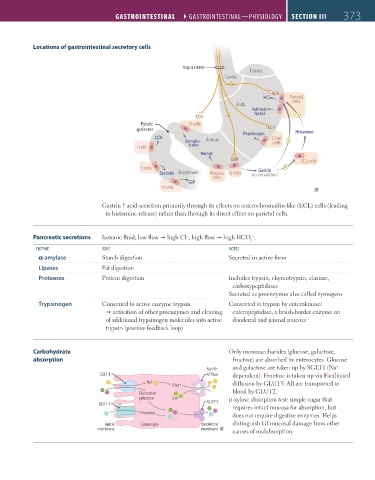
Locations of gastrointestinal secretory cells
Vagus nerve
Fundus
Cardia
ACh
HCl Parietal
Body cells
Intrinsic
ACh factor
Pyloric D cells
sphincter ACh
Pepsinogen Histamine
CCK Chief
Somato- Antrum cells
I cells statin
Mucus
GRP ECL cells
S cells Gastrin
Secretin Duodenum Mucous G cells (to circulation)
cells
GIP
K cells
Gastrin acid secretion primarily through its effects on enterochromaffin-like (ECL) cells (leading
to histamine release) rather than through its direct effect on parietal cells.
Pancreatic secretions Isotonic fluid; low flow high Cl , high flow high HCO .
−
−
3
enZyme role notes
α-amylase Starch digestion Secreted in active form
Lipases Fat digestion
Proteases Protein digestion Includes trypsin, chymotrypsin, elastase,
carboxypeptidases
Secreted as proenzymes also called zymogens
Trypsinogen Converted to active enzyme trypsin Converted to trypsin by enterokinase/
activation of other proenzymes and cleaving enteropeptidase, a brush-border enzyme on
of additional trypsinogen molecules into active duodenal and jejunal mucosa
trypsin (positive feedback loop)
Carbohydrate Only monosaccharides (glucose, galactose,
absorption fructose) are absorbed by enterocytes. Glucose
+
Na + /K + and galactose are taken up by SGLT1 (Na
SGLT-1 ATPase dependent). Fructose is taken up via Facilitated
Na + diffusion by GLUT5. All are transported to
3 Na +
Glucose or blood by GLUT2.
galactose 2 K + d-xylose absorption test: simple sugar that
GLUT-5 GLUT-2
requires intact mucosa for absorption, but
Fructose
does not require digestive enzymes. Helps
Apical Enterocyte Basolateral distinguish GI mucosal damage from other
membrane membrane causes of malabsorption.
FAS1_2019_09-Gastrointestinal.indd 373 11/7/19 4:42 PM

