


Page 490 - First Aid for the USMLE Step 1 2020, Thirtieth edition [MedicalBooksVN.com]_Neat
P. 490
`
anatomy and physiology
Don’t delete
446 section iii Musculoskeletal, skin, and connective tissue ` anatomy and physiology Musculoskeletal, skin, and connective tissue ` anatomy and physiology
` mUsCUlosKElEtal, sKin, and ConnECtiVE tissUE—anatomy and physiology
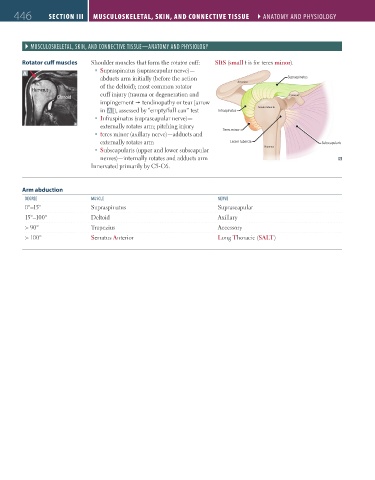
Rotator cuff muscles Shoulder muscles that form the rotator cuff: SItS (small t is for teres minor).
Supraspinatus (suprascapular nerve)—
A
abducts arm initially (before the action Supraspinatus
of the deltoid); most common rotator Acromion
Humerus cuff injury (trauma or degeneration and
Glenoid Coracoid
impingement tendinopathy or tear [arrow
in A ]), assessed by “empty/full can” test Infraspinatus Greater tubercle
Infraspinatus (suprascapular nerve)—
externally rotates arm; pitching injury Teres minor
teres minor (axillary nerve)—adducts and
externally rotates arm Lesser tubercle Subscapularis
Subscapularis (upper and lower subscapular Humerus
nerves)—internally rotates and adducts arm
Innervated primarily by C5-C6.
Arm abduction
dEgREE mUsClE nERVE
0°–15° Supraspinatus Suprascapular
15°–100° Deltoid Axillary
> 90° Trapezius Accessory
> 100° Serratus Anterior Long Thoracic (SALT)
FAS1_2019_11-Musculo.indd 446 11/7/19 5:23 PM

