


Page 551 - First Aid for the USMLE Step 1 2020, Thirtieth edition [MedicalBooksVN.com]_Neat
P. 551
Neurology aNd Special SeNSeS  `  neurology—AnAtomy And Physiology  Neurology aNd Special SeNSeS  `  neurology—AnAtomy And Physiology  SecTioN iii  507


                  Cranial nerve reflexes
                   reFleX                AFFerent                                 eFFerent
                   Corneal               V  ophthalmic (nasociliary branch)       Bilateral VII (temporal branch—orbicularis
                                          1
                                                                                   oculi)
                   Lacrimation           V  (loss of reflex does not preclude emotional   VII
                                          1
                                          tears)
                   Jaw jerk              V  (sensory—muscle spindle from masseter)  V  (motor—masseter)
                                          3                                         3
                   Pupillary             II                                       III
                   Gag                   IX                                       X
                   Cough                 X                                        X


                  Mastication muscles    3 muscles close jaw: Masseter, teMporalis,   M’s Munch.
                                          Medial pterygoid. 1 opens: Lateral pterygoid.   Lateral Lowers (when speaking of pterygoids
                                          All are innervated by trigeminal nerve (V ).  with respect to jaw motion).
                                                                            3
                                                                                  “It takes more muscle to keep your mouth shut.”


                  Spinal nerves          There are 31 pairs of spinal nerves: 8 cervical, 12 thoracic, 5 lumbar, 5 sacral, 1 coccygeal.
                                         Nerves C1–C7 exit above the corresponding vertebrae (eg, C3 exits above the 3rd cervical vertebra).
                                          C8 spinal nerve exits below C7 and above T1. All other nerves exit below (eg, L2 exits below the
                                          2nd lumbar vertebra).


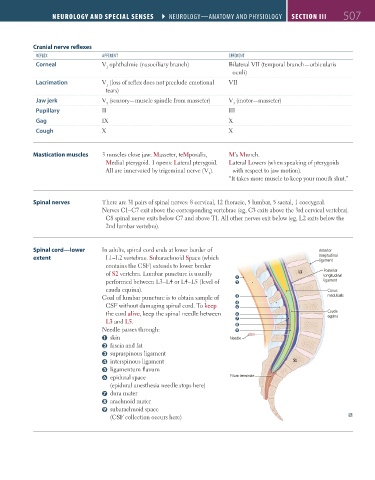
                  Spinal cord—lower      In adults, spinal cord ends at lower border of                         Anterior
                  extent                  L1–L2 vertebrae. Subarachnoid Space (which                            longitudinal
                                                                                                                ligament
                                          contains the CSF) extends to lower border
                                          of S2 vertebra. Lumbar puncture is usually   Q                 L1      Posterior
                                                                                                                 longitudinal
                                          performed between L3–L4 or L4–L5 (level of   R                         ligament
                                          cauda equina).                                                           Conus
                                         Goal of lumbar puncture is to obtain sample of   S                        medullaris
                                          CSF without damaging spinal cord. To keep   T
                                                                                    U
                                          the cord alive, keep the spinal needle between   V                       Cauda
                                                                                                                   equina
                                          L3 and L5.                                W
                                                                                    X
                                         Needle passes through:                     Y
                                             skin                                  Needle
                                             fascia and fat
                                             supraspinous ligament
                                             interspinous ligament                                     S1
                                             ligamentum flavum
                                              epidural space                       Filum terminale
                                            (epidural anesthesia needle stops here)
                                             dura mater
                                             arachnoid mater
                                              subarachnoid space
                                            (CSF collection occurs here)


          FAS1_2019_12-Neurol.indd   507                                                                                11/8/19   7:39 AM

