


Page 108 - The City and Guilds Textbook: Plumbing Book 1 for the Level 3 Apprenticeship (9189), Level 2 Technical Certificate (8202) and Level 2 Diploma (6035)
P. 108
The City & Guilds Textbook: Plumbing Book 1

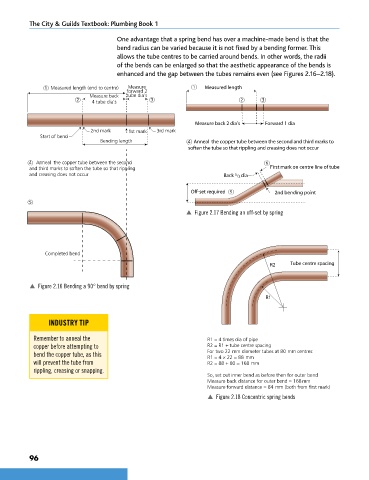
                                            One advantage that a spring bend has over a machine-made bend is that the
                                            bend radius can be varied because it is not fixed by a bending former. This
                                            allows the tube centres to be carried around bends. In other words, the radii
                                            of the bends can be enlarged so that the aesthetic appearance of the bends is
                                            enhanced and the gap between the tubes remains even (see Figures 2.16–2.18).
                                                Measure
                     1  Measured length (end to centre)   forward 2  1   Measured length
                                   Measure back  tube dia's
                               2    4 tube dia's       3                            2      3


                                                                      Measure back 2 dia's  Forward 1 dia
                                    2nd mark    1st mark  3rd mark
                   Start of bend
                                       Bending length              4      Anneal  the copper tube between the second and third marks to
                                                                   soften the tube so that rippling and creasing does not occur

                     Anneal  the copper tube between the second                             6
                4
                and third marks to soften the tube so that rippling                           First mark on centre line of tube
                and creasing does not occur                                    Back  1 /2   dia

                                                                    Off-set required  5        2nd bending point

                5
                                                                   p  Figure 2.17 Bending an off-set by spring


                     Completed bend
                                                                                              R2    Tube centre spacing


                p  Figure 2.16 Bending a 90° bend by spring

                                                                                            R1


                      INDUSTRY TIP

                 Remember to anneal the                                  R1 = 4 times dia of pipe
                 copper before attempting to                             R2 = R1 + tube centre spacing
                 bend the copper tube, as this                           For two 22 mm diameter tubes at 80 mm centres:
                                                                         R1 = 4 × 22 = 88 mm
                 will prevent the tube from                              R2 = 88 + 80 = 168  mm
                 rippling, creasing or snapping.
                                                                         So, set out inner bend as before then for outer bend
                                                                         Measure back distance for outer bend = 168 mm
                                                                         Measure forward distance = 84 mm (both from first mark)
                                                                         p  Figure 2.18 Concentric spring bends


                96


        9781510416482.indb   96                                                                                     29/03/19   8:52 PM

