


Page 111 - The City and Guilds Textbook: Plumbing Book 1 for the Level 3 Apprenticeship (9189), Level 2 Technical Certificate (8202) and Level 2 Diploma (6035)
P. 111
Chapter 2 Common processes and techniques

                to 240°C and is suitable for making end feed capillary joints on all domestic
                plumbing, heating and gas systems.

                The use of leaded solder is permitted for use on gas and central heating installations,
                but there is always a risk that this solder will be used on the wrong system and, if
                this occurs, the plumber risks a hefty fine and a criminal record if prosecuted.

                Fluxes are used to clean oxides from the surface of the copper and to help with
                the flow of solder into the fitting. There are two basic forms of flux available:

                1  Active fluxes: otherwise known as ‘self-cleaning’ flux because it cleans the
                   copper tube and the fitting during the soldering process. Cleaning of the
                   tube and fittings beforehand is not necessary. Some types of active flux
                   are known to contain hydrochloric acid, which can be harmful if not used
                   correctly and can promote corrosion in copper tubes if excess flux is not
                   removed after soldering has been completed. They are, however, potable in
                   water, which means they dissolve in contact with water and are flushed out
                   when initial flushing of the system takes place.
                2  Traditional flux paste: usually made from zinc chloride and/or zinc ammonium
                   chlorides. Some fluxes contain other active ingredients such as amines. Cleaning
                   of the tube and fitting is required with this type of flux and it is not potable. It
                   will remain in the pipe after the soldering process has been completed and will
                   not flush out during commissioning, so it should be used sparingly.

                Compression fittings to BS EN 1254:1998

                Compression-type fittings are mechanical fittings that require tightening with a
                spanner to make a watertight joint. There are two different types:

                1  type A – non-manipulative compression fittings
                2  type B – manipulative compression fittings.

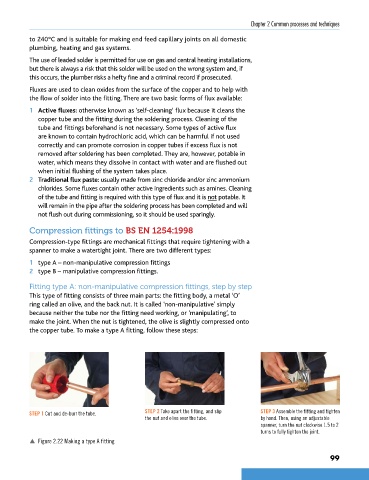
                Fitting type A: non-manipulative compression fittings, step by step
                This type of fitting consists of three main parts: the fitting body, a metal ‘O’
                ring called an olive, and the back nut. It is called ‘non-manipulative’ simply
                because neither the tube nor the fitting need working, or ‘manipulating’, to
                make the joint. When the nut is tightened, the olive is slightly compressed onto
                the copper tube. To make a type A fitting, follow these steps:


                STEP 1 Cut and de-burr the tube.     STEP 2 Take apart the fitting, and slip   STEP 3 Assemble the fitting and tighten
                                                     the nut and olive over the tube.      by hand. Then, using an adjustable
                                                                                           spanner, turn the nut clockwise 1.5 to 2
                                                                                           turns to fully tighten the joint.
                p  Figure 2.22 Making a type A fitting

                                                                                                                 99


        9781510416482.indb   99                                                                                     29/03/19   8:52 PM

