


Page 110 - The City and Guilds Textbook: Plumbing Book 1 for the Level 3 Apprenticeship (9189), Level 2 Technical Certificate (8202) and Level 2 Diploma (6035)
P. 110
The City & Guilds Textbook: Plumbing Book 1

                                            Capillary fittings to BS EN 1254:1998

                                            Capillary fittings use the principle of capillary action to draw solder into the
                                            fitting when they are heated by a blowtorch. There are two different types:
                                            1  Integral solder ring: this type of fitting has a band of lead-free solder housed
                                               inside a raised ring on the fitting socket, so extra solder is not needed.
                                            2  End feed: this type of fitting needs solder to be fed at the end or the mouth
                                               of the fitting. It does not have solder in the fitting.

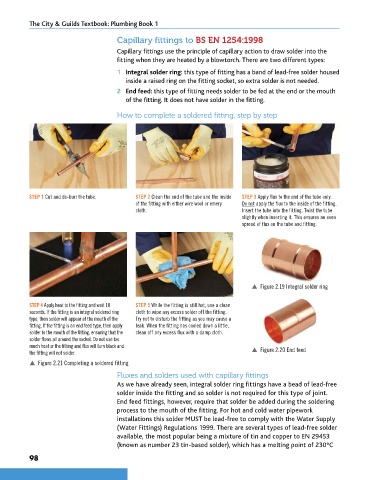
                                            How to complete a soldered fitting, step by step


                STEP 1 Cut and de-burr the tube.  STEP 2 Clean the end of the tube and the inside    STEP 3 Apply flux to the end of the tube only.
                                                  of the fitting with either wire wool or emery   Do not apply the flux to the inside of the fitting.
                                                  cloth.                             Insert the tube into the fitting. Twist the tube
                                                                                     slightly when inserting it. This ensures an even
                                                                                     spread of flux on the tube and fitting.


                                                                                        p  Figure 2.19 Integral solder ring


                STEP 4 Apply heat to the fitting and wait 10   STEP 5 While the fitting is still hot, use a clean
                seconds. If the fitting is an integral soldered ring   cloth to wipe any excess solder off the fitting.
                type, then solder will appear at the mouth of the   Try not to disturb the fitting as you may cause a
                fitting. If the fitting is an end feed type, then apply   leak. When the fitting has cooled down a little,
                solder to the mouth of the fitting, ensuring that the   clean off any excess flux with a damp cloth.
                solder flows all around the socket. Do not use too
                much heat or the fitting and flux will turn black and
                the fitting will not solder.                                            p  Figure 2.20 End feed
                p  Figure 2.21 Completing a soldered fitting
                                            Fluxes and solders used with capillary fittings
                                            As we have already seen, integral solder ring fittings have a bead of lead-free
                                            solder inside the fitting and so solder is not required for this type of joint.
                                            End feed fittings, however, require that solder be added during the soldering
                                            process to the mouth of the fitting. For hot and cold water pipework
                                            installations this solder MUST be lead-free to comply with the Water Supply
                                            (Water Fittings) Regulations 1999. There are several types of lead-free solder
                                            available, the most popular being a mixture of tin and copper to EN 29453
                                            (known as number 23 tin-based solder), which has a melting point of 230°C

                98


        9781510416482.indb   98                                                                                     29/03/19   8:52 PM

