


Page 131 - The City and Guilds Textbook: Plumbing Book 1 for the Level 3 Apprenticeship (9189), Level 2 Technical Certificate (8202) and Level 2 Diploma (6035)
P. 131
Chapter 2 Common processes and techniques

                ●  Let the customer know when any of the services, i.e. water, gas or electricity,
                   or appliances such as the WC, are going to be turned off or taken out of      INDUSTRY TIP
                   service, and ensure that they have collected enough water for the period of   If you are going to be working
                   temporary decommission; or, if working on a central heating system, ensure   outside, politely ask the
                   they have access to other forms of heat, especially during cold weather.  customer to move their car
                                                                                            before you begin work so that
                  VALUES AND BEHAVIOURS                                                     it does not get damaged.
                                                                                            ●  Cover with dust sheets
                  Early-morning arrivals are not always welcome.                               all furniture, carpets and
                                                                                               fixtures that cannot be
                  It is good practice to keep customers informed of any inconveniences that    removed in the area where
                  could be caused by the work that may affect their day-to-day routine.
                                                                                               you are going to work.
                                                                                            ●  Before work begins, agree
                                                                                               with the customer the
                 IMPROVE YOUR ENGLISH                                                          position of radiators,
                 Clear and open communication with your customer will always be appreciated.   boilers and all visible
                 Make sure you explain to them any unforeseen problems that arise, and allow   pipework. When fitting
                 them to discuss possible solutions so they feel well informed about any changes   sanitary ware, make
                 that may incur extra costs or impact the schedule.                            sure you are fitting the
                                                                                               appliances in the position
                                                                                               that the customer wants.
                Preparation of the work area: lifting                                       ●  Keep the customer
                floorboards, notching and drilling joists,                                     informed about any
                                                                                               problems that arise that
                and chasing walls                                                              may need them to make a

                Much of the work in occupied and existing dwellings involves installing pipework   decision.
                under floors, in walls and through walls. In this part of the chapter, we will look
                at the procedure for lifting floorboards, notching and drilling joists, and chasing
                walls to allow the installation of pipework.


                Lifting floorboards using power tools, step by step

                1  Decide on the boards to be lifted, and mark them with a pencil.
                2  Locate the position of the joists. This can be done by searching for the row of
                   nails holding the board to the joist.
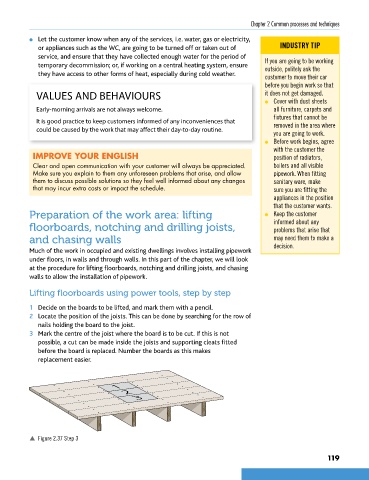
                3  Mark the centre of the joist where the board is to be cut. If this is not
                   possible, a cut can be made inside the joists and supporting cleats fitted
                   before the board is replaced. Number the boards as this makes
                   replacement easier.


                                            1
                                               2
                                                   3


                p  Figure 2.37 Step 3


                                                                                                                119


        9781510416482.indb   119                                                                                    29/03/19   8:54 PM

