


Page 133 - The City and Guilds Textbook: Plumbing Book 1 for the Level 3 Apprenticeship (9189), Level 2 Technical Certificate (8202) and Level 2 Diploma (6035)
P. 133
Chapter 2 Common processes and techniques


                3  Using a nail punch, punch the nails below the surface of the board.
                4  Set the depth on the circular saw just less than the depth of the board. This
                   is to ensure that any cables or services already installed are not damaged.
                5  Run down the length of the boards to be lifted with the circular saw to cut
                   the tongue of the board.
                6  Now, using the marks previously made, carefully cut across the board using
                   the circular saw.
                7  The board can now be lifted using a bolster chisel to prise it up.
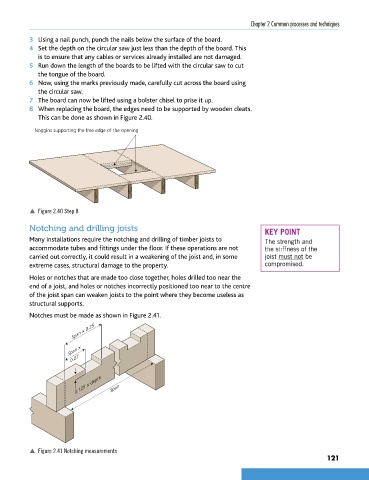
                8  When replacing the board, the edges need to be supported by wooden cleats.
                   This can be done as shown in Figure 2.40.

                  Noggins supporting the free edge of the opening


                p  Figure 2.40 Step 8

                Notching and drilling joists                                                KEY POINT

                Many installations require the notching and drilling of timber joists to    The strength and
                accommodate tubes and fittings under the floor. If these operations are not   the stiffness of the
                carried out correctly, it could result in a weakening of the joist and, in some   joist must not be
                extreme cases, structural damage to the property.                           compromised.

                Holes or notches that are made too close together, holes drilled too near the
                end of a joist, and holes or notches incorrectly positioned too near to the centre
                of the joist span can weaken joists to the point where they become useless as
                structural supports.
                Notches must be made as shown in Figure 2.41.
                              Span × 0.25


                            Span ×
                             0.07


                               0.125 × depth  Span


                p  Figure 2.41 Notching measurements
                                                                                                                121


        9781510416482.indb   121                                                                                    29/03/19   8:54 PM

