


Page 206 - The City and Guilds Textbook: Plumbing Book 1 for the Level 3 Apprenticeship (9189), Level 2 Technical Certificate (8202) and Level 2 Diploma (6035)
P. 206
The City & Guilds Textbook: Plumbing Book 1


                                            In electrical appliances, the earth wire in the flex is covered in yellow and
                                            green plastic and should be connected to the earth terminal of the plug. In the
                                            electrical installation (lighting and ring main) the earth wire is an unsheathed
                                            copper wire included in the cable between the neutral and live wires. A yellow/
                                            green coloured sheath has to be placed over it.
                                            When earthing the mains cold water and gas pipes, 10 mm  green and yellow
                                                                                                 2
                                            single-core earth wire should be used to clamp the wires within 600 mm of the
                                            meter or stop valve.
                                            Plastic pipes do not require earthing.

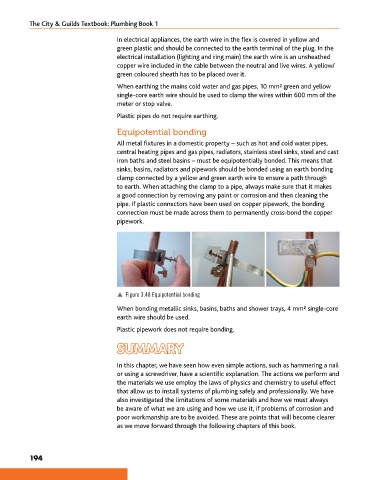
                                            Equipotential bonding

                                            All metal fixtures in a domestic property – such as hot and cold water pipes,
                                            central heating pipes and gas pipes, radiators, stainless steel sinks, steel and cast
                                            iron baths and steel basins – must be equipotentially bonded. This means that
                                            sinks, basins, radiators and pipework should be bonded using an earth bonding
                                            clamp connected by a yellow and green earth wire to ensure a path through
                                            to earth. When attaching the clamp to a pipe, always make sure that it makes
                                            a good connection by removing any paint or corrosion and then cleaning the
                                            pipe. If plastic connectors have been used on copper pipework, the bonding
                                            connection must be made across them to permanently cross-bond the copper
                                            pipework.


                                            p  Figure 3.48 Equipotential bonding

                                            When bonding metallic sinks, basins, baths and shower trays, 4 mm² single-core
                                            earth wire should be used.
                                            Plastic pipework does not require bonding.

                                            SUMMARY


                                            In this chapter, we have seen how even simple actions, such as hammering a nail
                                            or using a screwdriver, have a scientific explanation. The actions we perform and
                                            the materials we use employ the laws of physics and chemistry to useful effect
                                            that allow us to install systems of plumbing safely and professionally. We have
                                            also investigated the limitations of some materials and how we must always
                                            be aware of what we are using and how we use it, if problems of corrosion and
                                            poor workmanship are to be avoided. These are points that will become clearer
                                            as we move forward through the following chapters of this book.


                194


        9781510416482.indb   194                                                                                    29/03/19   8:55 PM

