


Page 204 - The City and Guilds Textbook: Plumbing Book 1 for the Level 3 Apprenticeship (9189), Level 2 Technical Certificate (8202) and Level 2 Diploma (6035)
P. 204
The City & Guilds Textbook: Plumbing Book 1


                                            The third bulb added is a 230 V, 10 W bulb, so we first need to calculate its
                                            resistance:

                                                  P
                                               I =   (from the power triangle) to find the current:
                                                  V
                                                    10 watts
                                               (I) =         = 0.0435 amps
                                                    230 volts
                                                   V    230
                                               R =   =        = 5287 Ω
                                                   I   0.0435
                 ACTIVITY                      Total resistance in the circuit = 5287 + 1322.6 + 1322.6 = 7932.2 Ω
                                                         V       230
                                               Therefore:   = I =      = 0.0290 amps
                 Series circuits                         R      7932.2
                 An electrical circuit in      V at R1 = I × R = 0.0290 × 5287 = 153.32 V
                 series has four light bulbs   V at R2 = I × R = 0.0290 × 1322.6 = 38.35 V
                 connected to it, one at 40
                 watts, one at 60 watts and    V at R3 = I × R = 0.0290 × 1322.6 = 38.35 V
                 two at 100 watts. Determine   Total volts = 230 V
                 the voltage consumed by    This shows that the bulb with the highest resistance (10 W) would draw
                 each light bulb when the
                 voltage is 110.            more of the voltage than the other two bulbs and would glow almost at full
                                            brightness, whereas the other 40 W bulbs would hardly glow at all.


                                            Parallel circuits
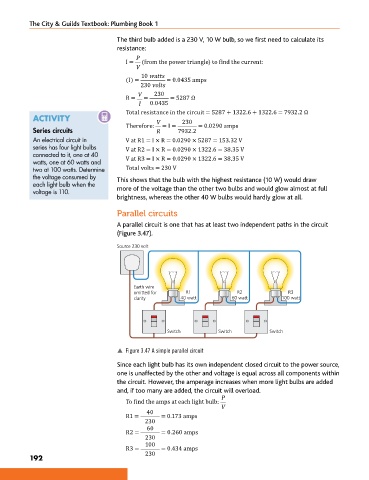
                                            A parallel circuit is one that has at least two independent paths in the circuit
                                            (Figure 3.47).
                                            Source 230 volt


                                                  Earth wire
                                                  omitted for      R1              R2               R3
                                                  clarity        40 watt         60 watt          100 watt


                                                            Switch           Switch           Switch

                                            p  Figure 3.47 A simple parallel circuit

                                            Since each light bulb has its own independent closed circuit to the power source,
                                            one is unaffected by the other and voltage is equal across all components within
                                            the circuit. However, the amperage increases when more light bulbs are added
                                            and, if too many are added, the circuit will overload.
                                                                              P
                                               To find the amps at each light bulb:
                                                                              V
                                                      40
                                               R1 =        = 0.173 amps
                                                     230
                                                      60
                                               R2 =        = 0.260 amps
                                                     230
                                                     100
                                               R3 =        = 0.434 amps
                192                                  230


        9781510416482.indb   192                                                                                    29/03/19   8:55 PM

