


Page 305 - The City and Guilds Textbook: Plumbing Book 1 for the Level 3 Apprenticeship (9189), Level 2 Technical Certificate (8202) and Level 2 Diploma (6035)
P. 305
Chapter 5 Cold water systems
Eliminating the risk of contamination
of wholesome water
The Water Regulations and, more specifically, the Water Regulations
Guide can help us to choose the right course of action based upon
the risk. Manufacturers, too, help in this regard by designing and Non- verifiable
manufacturing their appliances, taps and valves to conform to the Water double check
valve
Regulations. For example, most kitchen and bidet taps are designed and
made with fluid category 5 risk in mind, and most bath and washbasin
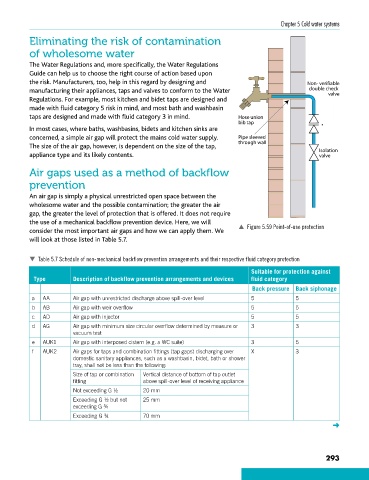
taps are designed and made with fluid category 3 in mind. Hose union
bib tap
In most cases, where baths, washbasins, bidets and kitchen sinks are
concerned, a simple air gap will protect the mains cold water supply. Pipe sleeved
through wall
The size of the air gap, however, is dependent on the size of the tap,
appliance type and its likely contents. Isolation
valve
Air gaps used as a method of backflow
prevention
An air gap is simply a physical unrestricted open space between the
wholesome water and the possible contamination; the greater the air
gap, the greater the level of protection that is offered. It does not require
the use of a mechanical backflow prevention device. Here, we will
consider the most important air gaps and how we can apply them. We p Figure 5.59 Point-of-use protection
will look at those listed in Table 5.7.
Table 5.7 Schedule of non-mechanical backflow prevention arrangements and their respective fluid category protection
Suitable for protection against
Type Description of backflow prevention arrangements and devices fluid category
Back pressure Back siphonage
a AA Air gap with unrestricted discharge above spill-over level 5 5
b AB Air gap with weir overflow 5 5
c AD Air gap with injector 5 5
d AG Air gap with minimum size circular overflow determined by measure or 3 3
vacuum test
e AUK1 Air gap with interposed cistern (e.g. a WC suite) 3 5
f AUK2 Air gaps for taps and combination fittings (tap gaps) discharging over X 3
domestic sanitary appliances, such as a washbasin, bidet, bath or shower
tray, shall not be less than the following:
Size of tap or combination Vertical distance of bottom of tap outlet
fitting above spill-over level of receiving appliance
Not exceeding G ½ 20 mm
Exceeding G ½ but not 25 mm
exceeding G ¾
Exceeding G ¾ 70 mm
➜
293
9781510416482.indb 293 29/03/19 8:58 PM

