


Page 300 - The City and Guilds Textbook: Plumbing Book 1 for the Level 3 Apprenticeship (9189), Level 2 Technical Certificate (8202) and Level 2 Diploma (6035)
P. 300
The City & Guilds Textbook: Plumbing Book 1

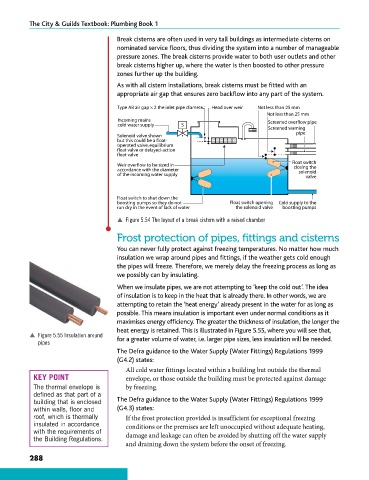
                                            Break cisterns are often used in very tall buildings as intermediate cisterns on
                                            nominated service floors, thus dividing the system into a number of manageable
                                            pressure zones. The break cisterns provide water to both user outlets and other
                                            break cisterns higher up, where the water is then boosted to other pressure
                                            zones further up the building.
                                            As with all cistern installations, break cisterns must be fitted with an
                                            appropriate air gap that ensures zero backflow into any part of the system.
                                            Type AB air gap × 2 the inlet pipe diameter  Head over weir  Not less than 25 mm
                                                                                             Not less than 25 mm
                                            Incoming mains                                   Screened overflow pipe
                                            cold water supply    S
                                                                                             Screened warning
                                                                                                      pipe
                                            Solenoid valve shown
                                            but this could be a float-
                                            operated valve, equilibrium
                                            float valve or delayed-action
                                            float valve
                                                                                                     Float switch
                                            Weir overflow to be sized in                             closing the
                                            accordance with the diameter                               solenoid
                                            of the incoming water supply
                                                                                                         valve

                                            Float switch to shut down the
                                            boosting pumps so they do not        Float switch opening  Cold supply to the
                                            run dry in the event of lack of water  the solenoid valve  boosting pumps
                                            p  Figure 5.54 The layout of a break cistern with a raised chamber

                                            Frost protection of pipes, fittings and cisterns

                                            You can never fully protect against freezing temperatures. No matter how much
                                            insulation we wrap around pipes and fittings, if the weather gets cold enough
                                            the pipes will freeze. Therefore, we merely delay the freezing process as long as
                                            we possibly can by insulating.

                                            When we insulate pipes, we are not attempting to ‘keep the cold out’. The idea
                                            of insulation is to keep in the heat that is already there. In other words, we are
                                            attempting to retain the ‘heat energy’ already present in the water for as long as
                                            possible. This means insulation is important even under normal conditions as it
                                            maximises energy efficiency. The greater the thickness of insulation, the longer the
                                            heat energy is retained. This is illustrated in Figure 5.55, where you will see that,
                p  Figure 5.55 Insulation around   for a greater volume of water, i.e. larger pipe sizes, less insulation will be needed.
                   pipes
                                            The Defra guidance to the Water Supply (Water Fittings) Regulations 1999
                                            (G4.2) states:
                                               All cold water fittings located within a building but outside the thermal
                 KEY POINT                     envelope, or those outside the building must be protected against damage

                 The thermal envelope is       by freezing.
                 defined as that part of a
                 building that is enclosed   The Defra guidance to the Water Supply (Water Fittings) Regulations 1999
                 within walls, floor and    (G4.3) states:
                 roof, which is thermally      If the frost protection provided is insufficient for exceptional freezing
                 insulated in accordance       conditions or the premises are left unoccupied without adequate heating,
                 with the requirements of      damage and leakage can often be avoided by shutting off the water supply
                 the Building Regulations.
                                               and draining down the system before the onset of freezing.

                288


        9781510416482.indb   288                                                                                    29/03/19   8:58 PM

