


Page 301 - The City and Guilds Textbook: Plumbing Book 1 for the Level 3 Apprenticeship (9189), Level 2 Technical Certificate (8202) and Level 2 Diploma (6035)
P. 301
Chapter 5 Cold water systems
The Defra guidance to the Water Supply (Water Fittings) Regulations 1999
(G4.4) states: INDUSTRY TIP
Where low temperatures persist, insulation will only delay the onset There are two conditions used
of freezing. Its efficiency is dependent upon its thickness and thermal to determine the thickness of
conductivity in relation to the pipe size, the time of exposure, the location pipe insulation required:
and, possibly, the wind chill factor. l Normal condition refers to
In general, all pipes and fittings that are installed in vulnerable or exposed the insulating of pipework
locations inside and outside a building, such as unheated cellars, roof spaces, under in unheated rooms of
ventilated suspended floors, garages and outbuildings, must be insulated. Where a building which has a
pipework is installed in a roof space, the pipes should still be insulated, even if they working heating system.
are placed below the roof insulation. This is to avoid unnecessary warming by heat All unheated rooms that
from the rooms below. The thickness of the insulation will, as we have already contain pipework should
be protected from freezing,
seen, be dependent upon the size of the pipe. Where pipes are located outside the e.g. cloakrooms, store
dwelling, the insulation should be to external standards and waterproof. rooms, utility rooms etc.
l Extreme conditions
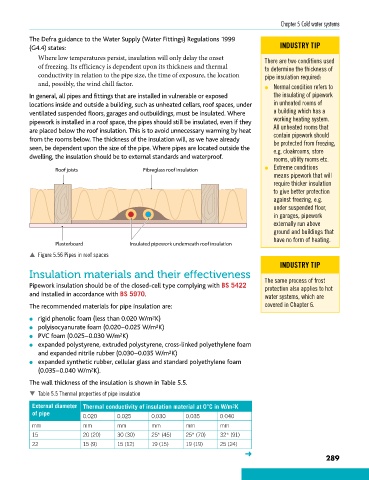
Roof joists Fibreglass roof insulation
means pipework that will
require thicker insulation
to give better protection
against freezing, e.g.
under suspended floor,
in garages, pipework
externally run above
ground and buildings that
have no form of heating.
Plasterboard Insulated pipework underneath roof insulation
p Figure 5.56 Pipes in roof spaces
INDUSTRY TIP
Insulation materials and their effectiveness
Pipework insulation should be of the closed-cell type complying with BS 5422 The same process of frost
protection also applies to hot
and installed in accordance with BS 5970. water systems, which are
The recommended materials for pipe insulation are: covered in Chapter 6.
2
● rigid phenolic foam (less than 0.020 W/m K)
2
● polyisocyanurate foam (0.020–0.025 W/m K)
● PVC foam (0.025–0.030 W/m K)
2
● expanded polystyrene, extruded polystyrene, cross-linked polyethylene foam
2
and expanded nitrile rubber (0.030–0.035 W/m K)
● expanded synthetic rubber, cellular glass and standard polyethylene foam
(0.035–0.040 W/m K).
2
The wall thickness of the insulation is shown in Table 5.5.
Table 5.5 Thermal properties of pipe insulation
External diameter Thermal conductivity of insulation material at 0°C in W/m K
2
of pipe 0.020 0.025 0.030 0.035 0.040
mm mm mm mm mm mm
15 20 (20) 30 (30) 25* (45) 25* (70) 32* (91)
22 15 (9) 15 (12) 19 (15) 19 (19) 25 (24)
➜
289
9781510416482.indb 289 29/03/19 8:58 PM

