


Page 316 - The City and Guilds Textbook: Plumbing Book 1 for the Level 3 Apprenticeship (9189), Level 2 Technical Certificate (8202) and Level 2 Diploma (6035)
P. 316
The City & Guilds Textbook: Plumbing Book 1

                                            Most RPZ valves consist of three separate elements:

                                            1  two check valves
                                            2  a differential relief valve
                                            3  three test points.

                                            The first check valve is spring loaded to generate a specific pressure drop across
                                            this part of the valve. This creates a reduced pressure zone downstream in the
                                            middle chamber of the valve and on the downstream side of the differential relief
                                            valve. The incoming mains supply maintains supply pressure on the upstream
                                            side of the differential valve and, as long as the mains pressure is higher, the
                                            differential relief valve will remain closed.
                                            If, under static conditions, the mains pressure reduces to where it is just 0.14
                                            bar above the pressure in the reduced pressure zone, the differential relief valve
                                            will open and release the contents of the middle chamber to drain. Should
                                            backflow occur past the first check valve element, the pressure on both sides
                                            of the differential valve will equalise and the differential relief valve will open
                                            to discharge the water.
                                            If complete mains failure occurs, the contents of the middle chamber are
                                            discharged to drain, provided that both check valve elements are functioning
                                            correctly. However, should the upstream check valve become faulty, the
                                            pressure in the middle chamber will equalise to that of mains pressure and the
                                            differential relief valve will open and continuously discharge water at a steady
                                            rate. If the downstream check valve fails under zero mains pressure conditions,
                                            the differential relief valve will open and water will discharge from the
                                            downstream side of the system until the pressure here also becomes zero.
                                            Testing, commissioning, maintenance and annual inspection can be carried out
                                            only by a trained and approved installer. Anyone who tests RPZ valves must be
                                            certificated. Specialist training is available from various test centres across the
                                            UK. Further recommended reading is the Water Regulations Advisory Scheme
                                            Information and Guidance Note No. 9-03-02.

                                            Type CA non-verifiable disconnector with difference
                                            between pressure zones not greater than 10 per cent

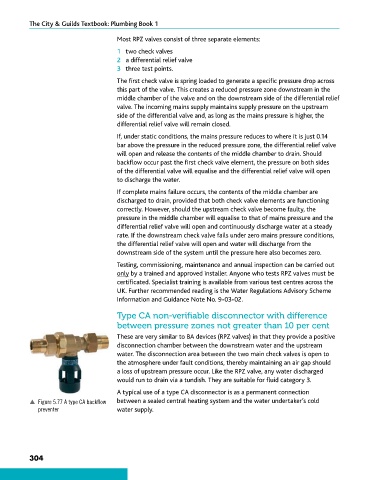
                                            These are very similar to BA devices (RPZ valves) in that they provide a positive
                                            disconnection chamber between the downstream water and the upstream
                                            water. The disconnection area between the two main check valves is open to
                                            the atmosphere under fault conditions, thereby maintaining an air gap should
                                            a loss of upstream pressure occur. Like the RPZ valve, any water discharged
                                            would run to drain via a tundish. They are suitable for fluid category 3.

                                            A typical use of a type CA disconnector is as a permanent connection
                p  Figure 5.77 A type CA backflow   between a sealed central heating system and the water undertaker’s cold
                   preventer                water supply.


                304


        9781510416482.indb   304                                                                                    29/03/19   8:58 PM

