


Page 41 - The City and Guilds Textbook: Plumbing Book 1 for the Level 3 Apprenticeship (9189), Level 2 Technical Certificate (8202) and Level 2 Diploma (6035)
P. 41
Chapter 1 Health and safety practices and systems

                All eye protection should be CE approved to the relevant European standards,
                including EN 166 and EN 172. Eye protection is a requirement by law under
                Regulation 4 of the Personal Protective Equipment at Work Regulations 1992
                when working in a hazardous area.
                In the event of an eye injury:

                ●  no medication is to be applied to the eye
                ●  the eye involved should be washed with clean, cold water if needed, and
                   covered with clean, dry material (if possible, cover the unaffected eye as well,
                   to reduce eye movement)
                ●  immediate medical attention should be sought
                ●  a thorough ophthalmic examination should be carried out within 24 hours.
                Respirators (respiratory protective equipment)

                Dust and fumes are a known hazard to health, especially when inhaled for long
                periods.
                The greatest problem on-site and in the workshop is the dust from common
                substances such as wood, cement, stone, silica and plastics. Cutting and grinding
                of these materials can often produce large amounts of dust, which can cause
                breathing problems such as asthma and emphysema. In general, the dust is too
                fine to be seen with the naked eye, but problems and symptoms can appear in
                later years.
                Fumes from solvents, paints and adhesives can also cause serious health
                problems, especially if used in confined or unventilated spaces.

                The Personal Protective Equipment at Work Regulations 1992 make provision for
                the protection of employees at work from dust and fumes, and also persons not
                employed who may be at risk.

                As well as providing respiratory protective equipment (RPE), suitable signs must
                be displayed where there is a chance of anyone coming into contact with dust
                and fumes from hazardous substances.
                It is the responsibility of the employer to carry out a risk assessment to
                determine when RPE is required and what type is appropriate to control the
                exposure to the hazardous material.

                Selecting the correct respirator
                The selection of the correct RPE must be carried out by a competent person.
                The choice will depend upon:
                ●  the nature of the hazard and material
                ●  the amount of dust present
                ●  the period of exposure
                ●  the weather conditions, if working outdoors
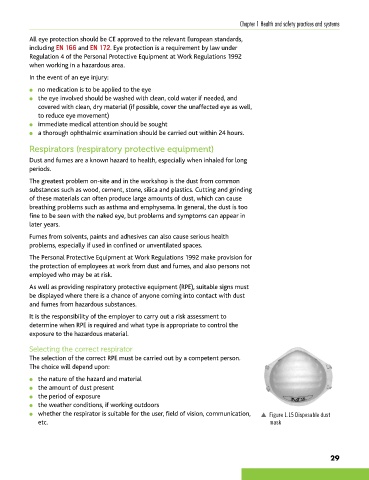
                ●  whether the respirator is suitable for the user, field of vision, communication,   p  Figure 1.15 Disposable dust
                   etc.                                                                       mask


                                                                                                                 29


        9781510416482.indb   29                                                                                     29/03/19   8:49 PM

