


Page 39 - The City and Guilds Textbook: Plumbing Book 1 for the Level 3 Apprenticeship (9189), Level 2 Technical Certificate (8202) and Level 2 Diploma (6035)
P. 39
Chapter 1 Health and safety practices and systems

                3 PERSONAL PROTECTION


                The purpose and use of personal

                protective equipment

                Personal protective equipment (PPE) is designed to create a barrier against
                workplace hazards. Health and safety law states that:
                ●  your employer must try to make the wearing of PPE unnecessary if at all
                   possible; if not, then:
                   ●  your employer must provide you with PPE
                   ●  your employer must train you in how to use PPE
                ●  you must use the PPE provided by your employer
                ●  you must take care of your PPE
                ●  you must report lost or damaged PPE to your supervisor.
                Depending on the type of workshop or site situation, the wearing of correct
                safety clothing and safe working practices are the best methods of avoiding
                accidents or injury.
                All construction operatives have a responsibility to safeguard themselves and
                others. Making provision to protect yourself often means wearing the correct
                protective clothing and safety equipment. Your employer is obliged by law to
                provide:

                ●  suitable protective clothing for working in the rain, snow, sleet, etc.
                ●  eye protection or eye shields for dust, sparks or flying objects
                ●  respirators, to avoid breathing dangerous dust and fumes
                ●  shelter accommodation for use when sheltering from bad weather
                ●  storage accommodation for protective clothing and equipment when not in
                   use
                ●  ear defenders where noise levels cannot be reduced below 80 dB(A) 8 hour
                ●  adequate protective clothing when exposed to high levels of lead, lead dust
                   or fumes, or paint
                ●  safety helmets for protection against falls of materials or protruding objects
                ●  industrial gloves for handling rough abrasives, sharp and coarse materials,
                   e.g. rough cast concrete or when using toxic or corrosive materials.

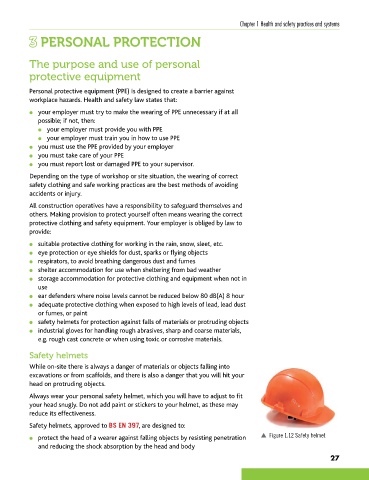
                Safety helmets

                While on-site there is always a danger of materials or objects falling into
                excavations or from scaffolds, and there is also a danger that you will hit your
                head on protruding objects.

                Always wear your personal safety helmet, which you will have to adjust to fit
                your head snugly. Do not add paint or stickers to your helmet, as these may
                reduce its effectiveness.

                Safety helmets, approved to BS EN 397, are designed to:
                ●  protect the head of a wearer against falling objects by resisting penetration   p  Figure 1.12 Safety helmet
                   and reducing the shock absorption by the head and body
                                                                                                                 27


        9781510416482.indb   27                                                                                     29/03/19   8:49 PM

