


Page 42 - The City and Guilds Textbook: Plumbing Book 1 for the Level 3 Apprenticeship (9189), Level 2 Technical Certificate (8202) and Level 2 Diploma (6035)
P. 42
The City & Guilds Textbook: Plumbing Book 1

                                            There are many types of RPE available, including:

                                            ●  disposable face masks
                                            ●  half dust respirators
                                            ●  high-efficiency dust respirators
                                            ●  ventilator visor or helmet respirators
                                            ●  compressed air line breathing apparatus
                                            ●  self-contained breathing apparatus.

                                            Gloves
                                            There are many instances in construction where the correct hand protection is
                                            a necessity. The type of glove required depends on the type of work. Your hands
                                            are vulnerable to a wide range of hazards, such as cuts, blows, chemical attack
                                            and temperature extremes, making it vital you choose the right gloves.
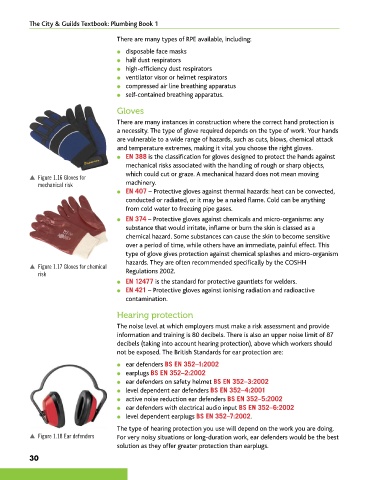
                                            ●  EN 388 is the classification for gloves designed to protect the hands against
                                               mechanical risks associated with the handling of rough or sharp objects,
                                               which could cut or graze. A mechanical hazard does not mean moving
                p  Figure 1.16 Gloves for
                   mechanical risk             machinery.
                                            ●  EN 407 – Protective gloves against thermal hazards: heat can be convected,
                                               conducted or radiated, or it may be a naked flame. Cold can be anything
                                               from cold water to freezing pipe gases.
                                            ●  EN 374 – Protective gloves against chemicals and micro-organisms: any
                                               substance that would irritate, inflame or burn the skin is classed as a
                                               chemical hazard. Some substances can cause the skin to become sensitive
                                               over a period of time, while others have an immediate, painful effect. This
                                               type of glove gives protection against chemical splashes and micro-organism
                                               hazards. They are often recommended specifically by the COSHH
                p  Figure 1.17 Gloves for chemical
                   risk                        Regulations 2002.
                                            ●  EN 12477 is the standard for protective gauntlets for welders.
                                            ●  EN 421 – Protective gloves against ionising radiation and radioactive
                                               contamination.

                                            Hearing protection
                                            The noise level at which employers must make a risk assessment and provide
                                            information and training is 80 decibels. There is also an upper noise limit of 87
                                            decibels (taking into account hearing protection), above which workers should
                                            not be exposed. The British Standards for ear protection are:
                                            ●  ear defenders BS EN 352–1:2002
                                            ●  earplugs BS EN 352–2:2002
                                            ●  ear defenders on safety helmet BS EN 352–3:2002
                                            ●  level dependent ear defenders BS EN 352–4:2001
                                            ●  active noise reduction ear defenders BS EN 352–5:2002
                                            ●  ear defenders with electrical audio input BS EN 352–6:2002
                                            ●  level dependent earplugs BS EN 352–7:2002.
                                            The type of hearing protection you use will depend on the work you are doing.
                p  Figure 1.18 Ear defenders  For very noisy situations or long-duration work, ear defenders would be the best
                                            solution as they offer greater protection than earplugs.
                30


        9781510416482.indb   30                                                                                     29/03/19   8:49 PM

