


Page 507 - The City and Guilds Textbook: Plumbing Book 1 for the Level 3 Apprenticeship (9189), Level 2 Technical Certificate (8202) and Level 2 Diploma (6035)
P. 507
Chapter 7 Central heating systems


                                                                                     Hot water
                                                                                     cylinder
                                                     Ground source                  Two-way
                                                     heat pump                      manifold
                                                              Pump            Pump


                           Buried captor or ‘slinky’                                     4
                                                                                        2 3  5  6
                                                                                         1  7
                                    Pump                                     Top view


                                                                                                    Underfloor heating circuits
                                                    The flow and return connections to
                                                    the thermostatic mixing valves enter
                                                    side by side
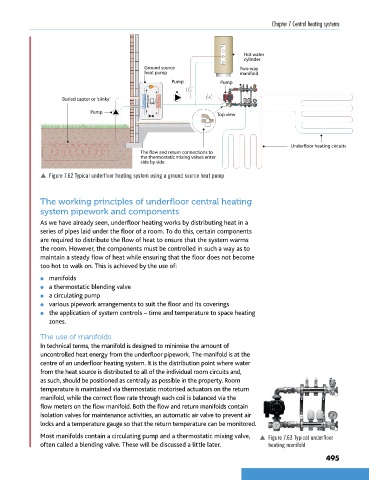
                   p  Figure 7.62 Typical underfloor heating system using a ground source heat pump


                   The working principles of underfloor central heating
                   system pipework and components

                   As we have already seen, underfloor heating works by distributing heat in a
                   series of pipes laid under the floor of a room. To do this, certain components
                   are required to distribute the flow of heat to ensure that the system warms
                   the room. However, the components must be controlled in such a way as to
                   maintain a steady flow of heat while ensuring that the floor does not become
                   too hot to walk on. This is achieved by the use of:

                   l  manifolds
                   l  a thermostatic blending valve
                   l  a circulating pump
                   l  various pipework arrangements to suit the floor and its coverings
                   l  the application of system controls – time and temperature to space heating
                      zones.
                   The use of manifolds
                   In technical terms, the manifold is designed to minimise the amount of
                   uncontrolled heat energy from the underfloor pipework. The manifold is at the
                   centre of an underfloor heating system. It is the distribution point where water
                   from the heat source is distributed to all of the individual room circuits and,
                   as such, should be positioned as centrally as possible in the property. Room
                   temperature is maintained via thermostatic motorised actuators on the return
                   manifold, while the correct flow rate through each coil is balanced via the
                   flow meters on the flow manifold. Both the flow and return manifolds contain
                   isolation valves for maintenance activities, an automatic air valve to prevent air
                   locks and a temperature gauge so that the return temperature can be monitored.

                   Most manifolds contain a circulating pump and a thermostatic mixing valve,   p  Figure 7.63 Typical underfloor
                   often called a blending valve. These will be discussed a little later.    heating manifold

                                                                                                                495


        9781510416482.indb   495                                                                                    29/03/19   9:03 PM

