


Page 506 - The City and Guilds Textbook: Plumbing Book 1 for the Level 3 Apprenticeship (9189), Level 2 Technical Certificate (8202) and Level 2 Diploma (6035)
P. 506
The City & Guilds Textbook: Plumbing Book 1
a thermostatic blending valve to maintain the steady temperature required
for the underfloor system. Zoning the upstairs and downstairs circuits with
two-port motorised zone valves and independent time control for the heat
emitters also helps in this regard.
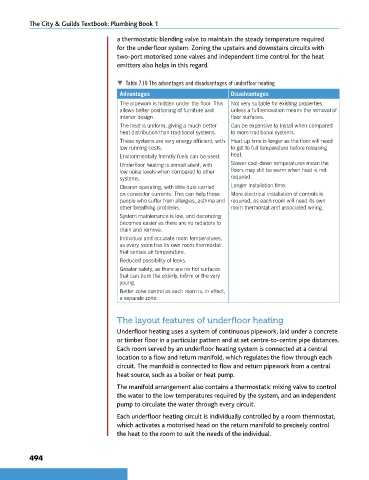
Table 7.19 The advantages and disadvantages of underfloor heating
Advantages Disadvantages
The pipework is hidden under the floor. This Not very suitable for existing properties
allows better positioning of furniture and unless a full renovation means the removal of
interior design. floor surfaces.
The heat is uniform, giving a much better Can be expensive to install when compared
heat distribution than traditional systems. to more traditional systems.
These systems are very energy efficient, with Heat-up time is longer as the floor will need
low running costs. to get to full temperature before releasing
Environmentally friendly fuels can be used. heat.
Underfloor heating is almost silent, with Slower cool-down temperatures mean the
low noise levels when compared to other floors may still be warm when heat is not
systems. required.
Cleaner operating, with little dust carried Longer installation time.
on convector currents. This can help those More electrical installation of controls is
people who suffer from allergies, asthma and required, as each room will need its own
other breathing problems. room thermostat and associated wiring.
System maintenance is low, and decorating
becomes easier as there are no radiators to
drain and remove.
Individual and accurate room temperatures,
as every room has its own room thermostat
that senses air temperature.
Reduced possibility of leaks.
Greater safety, as there are no hot surfaces
that can burn the elderly, infirm or the very
young.
Better zone control as each room is, in effect,
a separate zone.
The layout features of underfloor heating
Underfloor heating uses a system of continuous pipework, laid under a concrete
or timber floor in a particular pattern and at set centre-to-centre pipe distances.
Each room served by an underfloor heating system is connected at a central
location to a flow and return manifold, which regulates the flow through each
circuit. The manifold is connected to flow and return pipework from a central
heat source, such as a boiler or heat pump.
The manifold arrangement also contains a thermostatic mixing valve to control
the water to the low temperatures required by the system, and an independent
pump to circulate the water through every circuit.
Each underfloor heating circuit is individually controlled by a room thermostat,
which activates a motorised head on the return manifold to precisely control
the heat to the room to suit the needs of the individual.
494
9781510416482.indb 494 29/03/19 9:03 PM

