


Page 508 - The City and Guilds Textbook: Plumbing Book 1 for the Level 3 Apprenticeship (9189), Level 2 Technical Certificate (8202) and Level 2 Diploma (6035)
P. 508
The City & Guilds Textbook: Plumbing Book 1

                                            The thermostatic mixing (blending) valve
                                            Thermostatic mixing or blending valves are designed to mix the flow and
                                            return water from the heat source to the required temperature for the
                                            underfloor heating circuits. They are available in many different formats, the
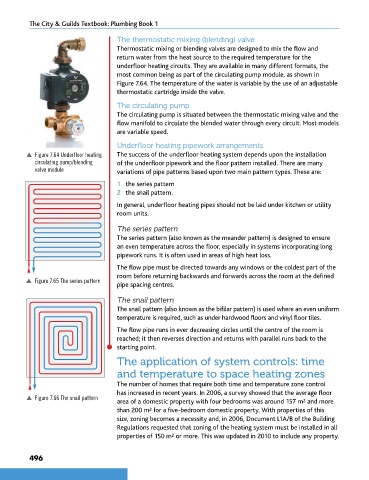
                                            most common being as part of the circulating pump module, as shown in
                                            Figure 7.64. The temperature of the water is variable by the use of an adjustable
                                            thermostatic cartridge inside the valve.

                                            The circulating pump
                                            The circulating pump is situated between the thermostatic mixing valve and the
                                            flow manifold to circulate the blended water through every circuit. Most models
                                            are variable speed.

                                            Underfloor heating pipework arrangements
               p  Figure 7.64 Underfloor heating   The success of the underfloor heating system depends upon the installation
                  circulating pump/blending   of the underfloor pipework and the floor pattern installed. There are many
                  valve module              variations of pipe patterns based upon two main pattern types. These are:

                                            1  the series pattern
                                            2  the snail pattern.
                                            In general, underfloor heating pipes should not be laid under kitchen or utility
                                            room units.

                                            The series pattern
                                            The series pattern (also known as the meander pattern) is designed to ensure
                                            an even temperature across the floor, especially in systems incorporating long
                                            pipework runs. It is often used in areas of high heat loss.

                                            The flow pipe must be directed towards any windows or the coldest part of the
                                            room before returning backwards and forwards across the room at the defined
               p  Figure 7.65 The series pattern
                                            pipe spacing centres.

                                            The snail pattern
                                            The snail pattern (also known as the bifilar pattern) is used where an even uniform
                                            temperature is required, such as under hardwood floors and vinyl floor tiles.
                                            The flow pipe runs in ever decreasing circles until the centre of the room is
                                            reached; it then reverses direction and returns with parallel runs back to the
                                            starting point.
                                            The application of system controls: time

                                            and temperature to space heating zones
                                            The number of homes that require both time and temperature zone control
                                            has increased in recent years. In 2006, a survey showed that the average floor
               p  Figure 7.66 The snail pattern
                                            area of a domestic property with four bedrooms was around 157 m  and more
                                                                                                        2
                                            than 200 m  for a five-bedroom domestic property. With properties of this
                                                       2
                                            size, zoning becomes a necessity and, in 2006, Document L1A/B of the Building
                                            Regulations requested that zoning of the heating system must be installed in all
                                                              2
                                            properties of 150 m  or more. This was updated in 2010 to include any property.

                496


        9781510416482.indb   496                                                                                    29/03/19   9:03 PM

