


Page 504 - The City and Guilds Textbook: Plumbing Book 1 for the Level 3 Apprenticeship (9189), Level 2 Technical Certificate (8202) and Level 2 Diploma (6035)
P. 504
The City & Guilds Textbook: Plumbing Book 1

                                            which makes the hot air rise. This adds up to a very warm ceiling! Underfloor
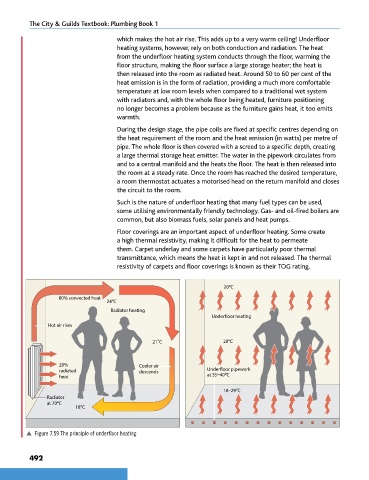
                                            heating systems, however, rely on both conduction and radiation. The heat
                                            from the underfloor heating system conducts through the floor, warming the
                                            floor structure, making the floor surface a large storage heater; the heat is
                                            then released into the room as radiated heat. Around 50 to 60 per cent of the
                                            heat emission is in the form of radiation, providing a much more comfortable
                                            temperature at low room levels when compared to a traditional wet system
                                            with radiators and, with the whole floor being heated, furniture positioning
                                            no longer becomes a problem because as the furniture gains heat, it too emits
                                            warmth.

                                            During the design stage, the pipe coils are fixed at specific centres depending on
                                            the heat requirement of the room and the heat emission (in watts) per metre of
                                            pipe. The whole floor is then covered with a screed to a specific depth, creating
                                            a large thermal storage heat emitter. The water in the pipework circulates from
                                            and to a central manifold and the heats the floor. The heat is then released into
                                            the room at a steady rate. Once the room has reached the desired temperature,
                                            a room thermostat actuates a motorised head on the return manifold and closes
                                            the circuit to the room.

                                            Such is the nature of underfloor heating that many fuel types can be used,
                                            some utilising environmentally friendly technology. Gas- and oil-fired boilers are
                                            common, but also biomass fuels, solar panels and heat pumps.
                                            Floor coverings are an important aspect of underfloor heating. Some create
                                            a high thermal resistivity, making it difficult for the heat to permeate
                                            them. Carpet underlay and some carpets have particularly poor thermal
                                            transmittance, which means the heat is kept in and not released. The thermal
                                            resistivity of carpets and floor coverings is known as their TOG rating.


                                                                               20ºC
                         80% convected heat
                                         24ºC
                                          Radiator heating
                                                                           Under oor heating
                      Hot air rises


                                                        21°C                   20ºC


                          20%                      Cooler air
                          radiated                 descends              Under oor pipework
                          heat                                           at 35 40ºC

                                                                               18 29ºC
                      Radiator
                      at 70ºC
                               18ºC


               p  Figure 7.59 The principle of underfloor heating


                492


        9781510416482.indb   492                                                                                    29/03/19   9:03 PM

