


Page 573 - The City and Guilds Textbook: Plumbing Book 1 for the Level 3 Apprenticeship (9189), Level 2 Technical Certificate (8202) and Level 2 Diploma (6035)
P. 573
Chapter 9 Sanitation systems


                             Flush pipe


                                                                    50mm


                195 mm


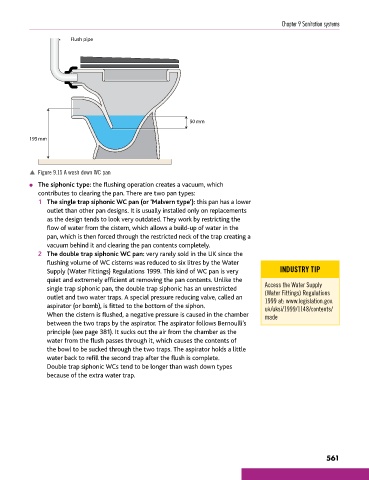
                p  Figure 9.15 A wash down WC pan

                ●  The siphonic type: the flushing operation creates a vacuum, which
                   contributes to clearing the pan. There are two pan types:
                   1  The single trap siphonic WC pan (or ‘Malvern type’): this pan has a lower
                      outlet than other pan designs. It is usually installed only on replacements
                      as the design tends to look very outdated. They work by restricting the
                      flow of water from the cistern, which allows a build-up of water in the
                      pan, which is then forced through the restricted neck of the trap creating a
                      vacuum behind it and clearing the pan contents completely.
                   2  The double trap siphonic WC pan: very rarely sold in the UK since the
                      flushing volume of WC cisterns was reduced to six litres by the Water
                      Supply (Water Fittings) Regulations 1999. This kind of WC pan is very      INDUSTRY TIP
                      quiet and extremely efficient at removing the pan contents. Unlike the
                      single trap siphonic pan, the double trap siphonic has an unrestricted   Access the Water Supply
                                                                                            (Water Fittings) Regulations
                      outlet and two water traps. A special pressure reducing valve, called an   1999 at: www.legislation.gov.
                      aspirator (or bomb), is fitted to the bottom of the siphon.           uk/uksi/1999/1148/contents/
                      When the cistern is flushed, a negative pressure is caused in the chamber   made
                      between the two traps by the aspirator. The aspirator follows Bernoulli’s
                      principle (see page 381). It sucks out the air from the chamber as the
                      water from the flush passes through it, which causes the contents of
                      the bowl to be sucked through the two traps. The aspirator holds a little
                      water back to refill the second trap after the flush is complete.
                      Double trap siphonic WCs tend to be longer than wash down types
                      because of the extra water trap.


                                                                                                                561


        9781510416482.indb   561                                                                                    29/03/19   9:05 PM

