


Page 569 - The City and Guilds Textbook: Plumbing Book 1 for the Level 3 Apprenticeship (9189), Level 2 Technical Certificate (8202) and Level 2 Diploma (6035)
P. 569
Chapter 9 Sanitation systems

                Air admittance valves
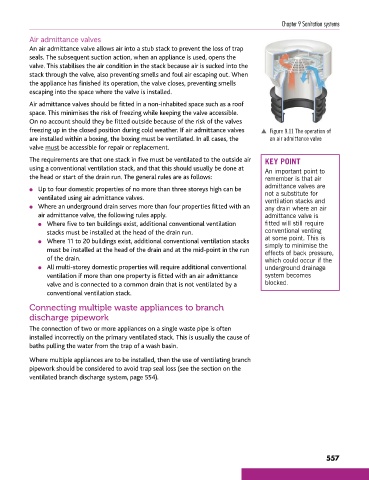
                An air admittance valve allows air into a stub stack to prevent the loss of trap
                seals. The subsequent suction action, when an appliance is used, opens the
                valve. This stabilises the air condition in the stack because air is sucked into the
                stack through the valve, also preventing smells and foul air escaping out. When
                the appliance has finished its operation, the valve closes, preventing smells
                escaping into the space where the valve is installed.

                Air admittance valves should be fitted in a non-inhabited space such as a roof
                space. This minimises the risk of freezing while keeping the valve accessible.
                On no account should they be fitted outside because of the risk of the valves
                freezing up in the closed position during cold weather. If air admittance valves   p  Figure 9.11 The operation of
                are installed within a boxing, the boxing must be ventilated. In all cases, the   an air admittance valve
                valve must be accessible for repair or replacement.

                The requirements are that one stack in five must be ventilated to the outside air   KEY POINT
                using a conventional ventilation stack, and that this should usually be done at   An important point to
                the head or start of the drain run. The general rules are as follows:       remember is that air
                                                                                            admittance valves are
                ●  Up to four domestic properties of no more than three storeys high can be   not a substitute for
                   ventilated using air admittance valves.                                  ventilation stacks and
                ●  Where an underground drain serves more than four properties fitted with an   any drain where an air
                   air admittance valve, the following rules apply.                         admittance valve is
                   ●  Where five to ten buildings exist, additional conventional ventilation   fitted will still require
                      stacks must be installed at the head of the drain run.                conventional venting
                   ●  Where 11 to 20 buildings exist, additional conventional ventilation stacks   at some point. This is
                                                                                            simply to minimise the
                      must be installed at the head of the drain and at the mid-point in the run   effects of back pressure,
                      of the drain.                                                         which could occur if the
                   ●  All multi-storey domestic properties will require additional conventional   underground drainage
                      ventilation if more than one property is fitted with an air admittance   system becomes
                      valve and is connected to a common drain that is not ventilated by a   blocked.
                      conventional ventilation stack.
                Connecting multiple waste appliances to branch
                discharge pipework

                The connection of two or more appliances on a single waste pipe is often
                installed incorrectly on the primary ventilated stack. This is usually the cause of
                baths pulling the water from the trap of a wash basin.

                Where multiple appliances are to be installed, then the use of ventilating branch
                pipework should be considered to avoid trap seal loss (see the section on the
                ventilated branch discharge system, page 554).


                                                                                                                557


        9781510416482.indb   557                                                                                    29/03/19   9:05 PM

