


Page 619 - The City and Guilds Textbook: Plumbing Book 1 for the Level 3 Apprenticeship (9189), Level 2 Technical Certificate (8202) and Level 2 Diploma (6035)
P. 619
Chapter 9 Sanitation systems

                Soundness testing, step by step

                Before testing begins, make a visual inspection of the system to ensure that
                it conforms to the British Standards, that you are happy with the clipping
                distances and that all joints appear to be made correctly.

                Testing should be completed in accordance with BS 12056–2.
                1  First, seal the pipework at the top and the bottom by using either drain plugs
                   or drain testing bags. The bottom drain plug can be inserted through the      INDUSTRY TIP
                   access cover at the base of the stack.                                   If the system is installed in a
                2  Fill all the traps on the system by letting a little water down each appliance   multi-storey property, it may
                   and a little water down the WC to cover the bottom plug. This will ensure   need to be tested in stages or
                   the plug’s airtightness.                                                 floor by floor.
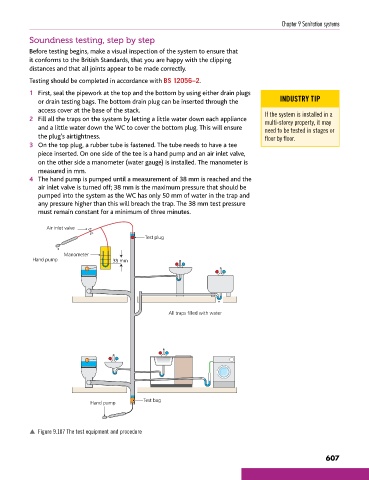
                3  On the top plug, a rubber tube is fastened. The tube needs to have a tee
                   piece inserted. On one side of the tee is a hand pump and an air inlet valve,
                   on the other side a manometer (water gauge) is installed. The manometer is
                   measured in mm.
                4  The hand pump is pumped until a measurement of 38 mm is reached and the
                   air inlet valve is turned off; 38 mm is the maximum pressure that should be
                   pumped into the system as the WC has only 50 mm of water in the trap and
                   any pressure higher than this will breach the trap. The 38 mm test pressure
                   must remain constant for a minimum of three minutes.


                     Air inlet valve
                                                     Test plug

                           Manometer
                 Hand pump                 38 mm


                                                             All traps filled with water


                                                     Test bag
                                    Hand pump


                p  Figure 9.107 The test equipment and procedure


                                                                                                                607


        9781510416482.indb   607                                                                                    29/03/19   9:08 PM

