


Page 620 - The City and Guilds Textbook: Plumbing Book 1 for the Level 3 Apprenticeship (9189), Level 2 Technical Certificate (8202) and Level 2 Diploma (6035)
P. 620
The City & Guilds Textbook: Plumbing Book 1


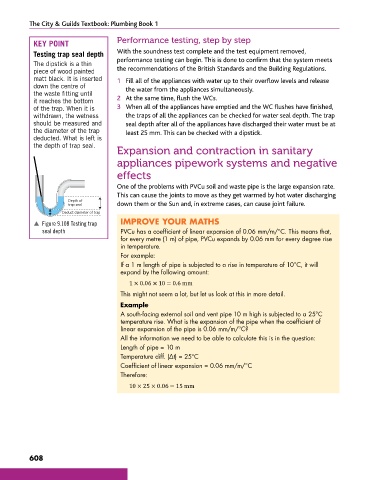
                 KEY POINT                  Performance testing, step by step
                 Testing trap seal depth    With the soundness test complete and the test equipment removed,

                 The dipstick is a thin     performance testing can begin. This is done to confirm that the system meets
                 piece of wood painted      the recommendations of the British Standards and the Building Regulations.
                 matt black. It is inserted   1  Fill all of the appliances with water up to their overflow levels and release
                 down the centre of            the water from the appliances simultaneously.
                 the waste fitting until
                 it reaches the bottom      2  At the same time, flush the WCs.
                 of the trap. When it is    3  When all of the appliances have emptied and the WC flushes have finished,
                 withdrawn, the wetness        the traps of all the appliances can be checked for water seal depth. The trap
                 should be measured and        seal depth after all of the appliances have discharged their water must be at
                 the diameter of the trap      least 25 mm. This can be checked with a dipstick.
                 deducted. What is left is
                 the depth of trap seal.
                                            Expansion and contraction in sanitary
                                            appliances pipework systems and negative

                                            effects
                                            One of the problems with PVCu soil and waste pipe is the large expansion rate.
                                            This can cause the joints to move as they get warmed by hot water discharging
                             Depth of
                             trap seal      down them or the Sun and, in extreme cases, can cause joint failure.
                           Deduct diameter of trap
                 p  Figure 9.108 Testing trap   IMPROVE YOUR MATHS
                    seal depth               PVCu has a coefficient of linear expansion of 0.06 mm/m/°C. This means that,
                                             for every metre (1 m) of pipe, PVCu expands by 0.06 mm for every degree rise
                                             in temperature.
                                             For example:
                                             If a 1 m length of pipe is subjected to a rise in temperature of 10°C, it will
                                             expand by the following amount:
                                                1 × 0.06 × 10 = 0.6 mm
                                             This might not seem a lot, but let us look at this in more detail.
                                             Example
                                             A south-facing external soil and vent pipe 10 m high is subjected to a 25°C
                                             temperature rise. What is the expansion of the pipe when the coefficient of
                                             linear expansion of the pipe is 0.06 mm/m/°C?
                                             All the information we need to be able to calculate this is in the question:
                                             Length of pipe = 10 m
                                             Temperature diff. (Δt) = 25°C
                                             Coefficient of linear expansion = 0.06 mm/m/°C
                                             Therefore:

                                                10 × 25 × 0.06 = 15 mm


                608


        9781510416482.indb   608                                                                                    29/03/19   9:08 PM

