


Page 615 - The City and Guilds Textbook: Plumbing Book 1 for the Level 3 Apprenticeship (9189), Level 2 Technical Certificate (8202) and Level 2 Diploma (6035)
P. 615
Chapter 9 Sanitation systems


                2  Place the pedestal into position and gently lower the washbasin, complete
                   with the waste trap fitted, onto the pedestal, ensuring that the centre
                   lines match. Do not use any silicone on the pedestal face at this time. It is
                   important first to ensure that the washbasin’s position is correct, that the
                   basin and pedestal match properly, and that the basin is level. Place a level
                   on the top of the washbasin and, once the appliance has been adjusted
                   level, mark the fixing holes underneath the basin and also mark around the
                   pedestal at floor level. This will ensure that both pedestal and basin go back
                   into the same position once the wall has been drilled.
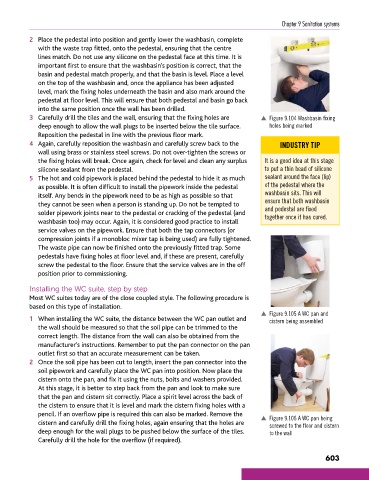
                3  Carefully drill the tiles and the wall, ensuring that the fixing holes are   p  Figure 9.104 Washbasin fixing
                   deep enough to allow the wall plugs to be inserted below the tile surface.   holes being marked
                   Reposition the pedestal in line with the previous floor mark.
                4  Again, carefully reposition the washbasin and carefully screw back to the     INDUSTRY TIP
                   wall using brass or stainless steel screws. Do not over-tighten the screws or
                   the fixing holes will break. Once again, check for level and clean any surplus   It is a good idea at this stage
                   silicone sealant from the pedestal.                                      to put a thin bead of silicone
                5  The hot and cold pipework is placed behind the pedestal to hide it as much   sealant around the face (lip)
                   as possible. It is often difficult to install the pipework inside the pedestal   of the pedestal where the
                   itself. Any bends in the pipework need to be as high as possible so that   washbasin sits. This will
                   they cannot be seen when a person is standing up. Do not be tempted to   ensure that both washbasin
                   solder pipework joints near to the pedestal or cracking of the pedestal (and   and pedestal are fixed
                                                                                            together once it has cured.
                   washbasin too) may occur. Again, it is considered good practice to install
                   service valves on the pipework. Ensure that both the tap connectors (or
                   compression joints if a monobloc mixer tap is being used) are fully tightened.
                   The waste pipe can now be finished onto the previously fitted trap. Some
                   pedestals have fixing holes at floor level and, if these are present, carefully
                   screw the pedestal to the floor. Ensure that the service valves are in the off
                   position prior to commissioning.

                Installing the WC suite, step by step
                Most WC suites today are of the close coupled style. The following procedure is
                based on this type of installation.
                                                                                           p  Figure 9.105 A WC pan and
                1  When installing the WC suite, the distance between the WC pan outlet and   cistern being assembled
                   the wall should be measured so that the soil pipe can be trimmed to the
                   correct length. The distance from the wall can also be obtained from the
                   manufacturer’s instructions. Remember to put the pan connector on the pan
                   outlet first so that an accurate measurement can be taken.
                2  Once the soil pipe has been cut to length, insert the pan connector into the
                   soil pipework and carefully place the WC pan into position. Now place the
                   cistern onto the pan, and fix it using the nuts, bolts and washers provided.
                   At this stage, it is better to step back from the pan and look to make sure
                   that the pan and cistern sit correctly. Place a spirit level across the back of
                   the cistern to ensure that it is level and mark the cistern fixing holes with a
                   pencil. If an overflow pipe is required this can also be marked. Remove the   p  Figure 9.106 A WC pan being
                   cistern and carefully drill the fixing holes, again ensuring that the holes are   screwed to the floor and cistern
                   deep enough for the wall plugs to be pushed below the surface of the tiles.   to the wall
                   Carefully drill the hole for the overflow (if required).

                                                                                                                603


        9781510416482.indb   603                                                                                    29/03/19   9:08 PM

