


Page 63 - The City and Guilds Textbook: Plumbing Book 1 for the Level 3 Apprenticeship (9189), Level 2 Technical Certificate (8202) and Level 2 Diploma (6035)
P. 63
Chapter 1 Health and safety practices and systems


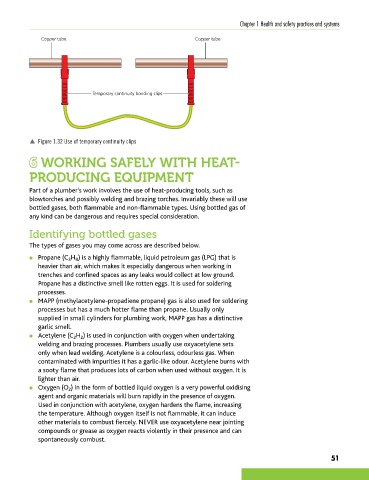
                    Copper tube                                       Copper tube


                                    Temporary continuity bonding clips


                p  Figure 1.32 Use of temporary continuity clips


                6 WORKING SAFELY WITH HEAT-

                PRODUCING EQUIPMENT

                Part of a plumber’s work involves the use of heat-producing tools, such as
                blowtorches and possibly welding and brazing torches. Invariably these will use
                bottled gases, both flammable and non-flammable types. Using bottled gas of
                any kind can be dangerous and requires special consideration.

                Identifying bottled gases

                The types of gases you may come across are described below.

                ●  Propane (C H ) is a highly flammable, liquid petroleum gas (LPG) that is
                            3
                               8
                   heavier than air, which makes it especially dangerous when working in
                   trenches and confined spaces as any leaks would collect at low ground.
                   Propane has a distinctive smell like rotten eggs. It is used for soldering
                   processes.
                ●  MAPP (methylacetylene-propadiene propane) gas is also used for soldering
                   processes but has a much hotter flame than propane. Usually only
                   supplied in small cylinders for plumbing work, MAPP gas has a distinctive
                   garlic smell.
                ●  Acetylene (C H ) is used in conjunction with oxygen when undertaking
                              2 2
                   welding and brazing processes. Plumbers usually use oxyacetylene sets
                   only when lead welding. Acetylene is a colourless, odourless gas. When
                   contaminated with impurities it has a garlic-like odour. Acetylene burns with
                   a sooty flame that produces lots of carbon when used without oxygen. It is
                   lighter than air.
                ●  Oxygen (O ) in the form of bottled liquid oxygen is a very powerful oxidising
                             2
                   agent and organic materials will burn rapidly in the presence of oxygen.
                   Used in conjunction with acetylene, oxygen hardens the flame, increasing
                   the temperature. Although oxygen itself is not flammable, it can induce
                   other materials to combust fiercely. NEVER use oxyacetylene near jointing
                   compounds or grease as oxygen reacts violently in their presence and can
                   spontaneously combust.


                                                                                                                 51


        9781510416482.indb   51                                                                                     29/03/19   8:50 PM

