


Page 638 - The City and Guilds Textbook: Plumbing Book 1 for the Level 3 Apprenticeship (9189), Level 2 Technical Certificate (8202) and Level 2 Diploma (6035)
P. 638
The City & Guilds Textbook: Plumbing Book 1
Types of coal
Coal is classified into four main types (see Table 10.4), depending on the amount
of carbon, oxygen and hydrogen present. The higher the carbon content, the
more energy the coal contains.
Table 10.4 The different types of commercially available coal
Coal type Heat content kW/kg Carbon content % Description
Lignite 2.2–5.5 25–35 The lowest type of coal, lignite is crumbly and has
high moisture content. Most lignite is used to produce
electricity.
Sub-bituminous 5.5–8.3 35–45 Typically contains less heating value than bituminous
coal, but more moisture.
Bituminous 7–10 45–86 Formed by added heat and pressure on lignite. Made
of many tiny layers, bituminous coal looks smooth and
sometimes shiny. It has two to three times the heating
value of lignite. Bituminous coal is used to generate
electricity, and is an important fuel for the steel and iron
industries.
Anthracite 10 86–97 Created where additional pressure combined with very
high temperature inside the Earth. It is deep black and
looks almost metallic due to its glossy surface.
Coal is still used for central heating boilers, both domestic and industrial, and
for steam and electricity generation.
Coke
Coke is produced by heating coal in coke ovens to around 1000°C. During this
process, the coal gives off methane gas and coal tar, both of which can be
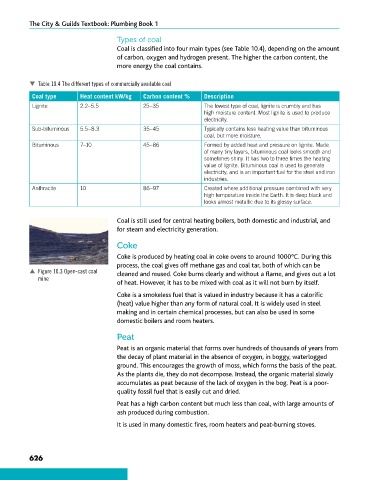
p Figure 10.3 Open-cast coal cleaned and reused. Coke burns clearly and without a flame, and gives out a lot
mine
of heat. However, it has to be mixed with coal as it will not burn by itself.
Coke is a smokeless fuel that is valued in industry because it has a calorific
(heat) value higher than any form of natural coal. It is widely used in steel
making and in certain chemical processes, but can also be used in some
domestic boilers and room heaters.
Peat
Peat is an organic material that forms over hundreds of thousands of years from
the decay of plant material in the absence of oxygen, in boggy, waterlogged
ground. This encourages the growth of moss, which forms the basis of the peat.
As the plants die, they do not decompose. Instead, the organic material slowly
accumulates as peat because of the lack of oxygen in the bog. Peat is a poor-
quality fossil fuel that is easily cut and dried.
Peat has a high carbon content but much less than coal, with large amounts of
ash produced during combustion.
It is used in many domestic fires, room heaters and peat-burning stoves.
626
9781510416482.indb 626 29/03/19 9:08 PM

