


Page 663 - The City and Guilds Textbook: Plumbing Book 1 for the Level 3 Apprenticeship (9189), Level 2 Technical Certificate (8202) and Level 2 Diploma (6035)
P. 663
Chapter 11 Electrical principles and processes for building services engineering

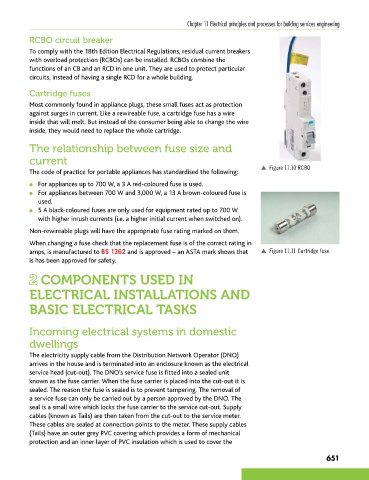
                RCBO circuit breaker

                To comply with the 18th Edition Electrical Regulations, residual current breakers
                with overload protection (RCBOs) can be installed. RCBOs combine the
                functions of an CB and an RCD in one unit. They are used to protect particular
                circuits, instead of having a single RCD for a whole building.

                Cartridge fuses

                Most commonly found in appliance plugs, these small fuses act as protection
                against surges in current. Like a rewireable fuse, a cartridge fuse has a wire
                inside that will melt. But instead of the consumer being able to change the wire
                inside, they would need to replace the whole cartridge.

                The relationship between fuse size and

                current
                                                                                           p  Figure 11.10 RCBO
                The code of practice for portable appliances has standardised the following:

                ●  For appliances up to 700 W, a 3 A red-coloured fuse is used.
                ●  For appliances between 700 W and 3,000 W, a 13 A brown-coloured fuse is
                   used.
                ●  5 A black-coloured fuses are only used for equipment rated up to 700 W
                   with higher inrush currents (i.e. a higher initial current when switched on).
                Non-rewireable plugs will have the appropriate fuse rating marked on them.

                When changing a fuse check that the replacement fuse is of the correct rating in
                amps, is manufactured to BS 1362 and is approved – an ASTA mark shows that   p  Figure 11.11 Cartridge fuse
                is has been approved for safety.

                2 COMPONENTS USED IN

                ELECTRICAL INSTALLATIONS AND

                BASIC ELECTRICAL TASKS


                Incoming electrical systems in domestic

                dwellings
                The electricity supply cable from the Distribution Network Operator (DNO)
                arrives in the house and is terminated into an enclosure known as the electrical
                service head (cut-out). The DNO’s service fuse is fitted into a sealed unit
                known as the fuse carrier. When the fuse carrier is placed into the cut-out it is
                sealed. The reason the fuse is sealed is to prevent tampering. The removal of
                a service fuse can only be carried out by a person approved by the DNO. The
                seal is a small wire which locks the fuse carrier to the service cut-out. Supply
                cables (known as Tails) are then taken from the cut-out to the service meter.
                These cables are sealed at connection points to the meter. These supply cables
                (Tails) have an outer grey PVC covering which provides a form of mechanical
                protection and an inner layer of PVC insulation which is used to cover the

                                                                                                                651


        9781510416482.indb   651                                                                                    29/03/19   9:09 PM

