


Page 666 - The City and Guilds Textbook: Plumbing Book 1 for the Level 3 Apprenticeship (9189), Level 2 Technical Certificate (8202) and Level 2 Diploma (6035)
P. 666
The City & Guilds Textbook: Plumbing Book 1
Electrical conduit is a metal or plastic pipe through which electrical wires are
run to a point of termination. The conduit protects the wires and is usually
used in exposed locations, such as along the outside surface of a wall. You will
see this most commonly where outside lighting has been added to a building’s
surface, or in offices.
Electrical conduit is fairly complex to fit – not dissimilar from some plumbing
materials.
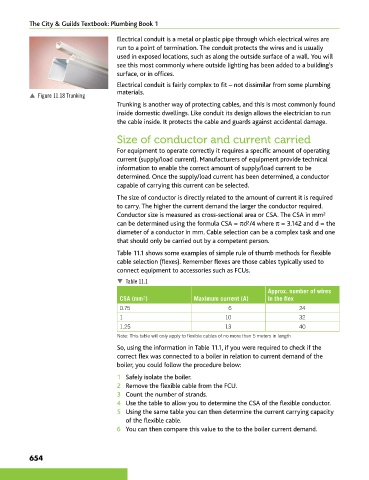
p Figure 11.18 Trunking
Trunking is another way of protecting cables, and this is most commonly found
inside domestic dwellings. Like conduit its design allows the electrician to run
the cable inside. It protects the cable and guards against accidental damage.
Size of conductor and current carried
For equipment to operate correctly it requires a specific amount of operating
current (supply/load current). Manufacturers of equipment provide technical
information to enable the correct amount of supply/load current to be
determined. Once the supply/load current has been determined, a conductor
capable of carrying this current can be selected.
The size of conductor is directly related to the amount of current it is required
to carry. The higher the current demand the larger the conductor required.
Conductor size is measured as cross-sectional area or CSA. The CSA in mm
2
can be determined using the formula CSA = πd /4 where π = 3.142 and d = the
2
diameter of a conductor in mm. Cable selection can be a complex task and one
that should only be carried out by a competent person.
Table 11.1 shows some examples of simple rule of thumb methods for flexible
cable selection (flexes). Remember flexes are those cables typically used to
connect equipment to accessories such as FCUs.
Table 11.1
Approx. number of wires
CSA (mm ) Maximum current (A) in the flex
2
0.75 6 24
1 10 32
1.25 13 40
Note: This table will only apply to flexible cables of no more than 5 meters in length.
So, using the information in Table 11.1, if you were required to check if the
correct flex was connected to a boiler in relation to current demand of the
boiler, you could follow the procedure below:
1 Safely isolate the boiler.
2 Remove the flexible cable from the FCU.
3 Count the number of strands.
4 Use the table to allow you to determine the CSA of the flexible conductor.
5 Using the same table you can then determine the current carrying capacity
of the flexible cable.
6 You can then compare this value to the to the boiler current demand.
654
9781510416482.indb 654 29/03/19 9:09 PM

