


Page 673 - The City and Guilds Textbook: Plumbing Book 1 for the Level 3 Apprenticeship (9189), Level 2 Technical Certificate (8202) and Level 2 Diploma (6035)
P. 673
Chapter 11 Electrical principles and processes for building services engineering

                Polarity can be checked by different methods, including visual inspection and
                continuity testing. The main point is to ensure that the line and neutral are not
                crossed over in a circuit.

                Polarity and continuity testing
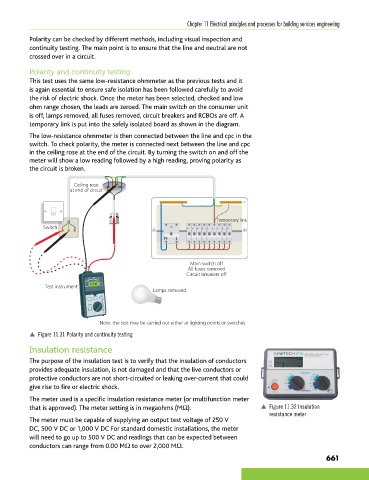
                This test uses the same low-resistance ohmmeter as the previous tests and it
                is again essential to ensure safe isolation has been followed carefully to avoid
                the risk of electric shock. Once the meter has been selected, checked and low
                ohm range chosen, the leads are zeroed. The main switch on the consumer unit
                is off, lamps removed, all fuses removed, circuit breakers and RCBOs are off. A
                temporary link is put into the safely isolated board as shown in the diagram.
                The low-resistance ohmmeter is then connected between the line and cpc in the
                switch. To check polarity, the meter is connected next between the line and cpc
                in the ceiling rose at the end of the circuit. By turning the switch on and off the
                meter will show a low reading followed by a high reading, proving polarity as
                the circuit is broken.

                              Ceiling rose
                             at end of circuit


                                                                             Temporary link
                    Switch


                                                                    Main switch off
                                                                   All fuses removed
                                                                   Circuit breakers off

                     Test instrument  0.20Ω
                                                        Lamps removed


                                       Note: the test may be carried out either at lighting points or switches
                p  Figure 11.31 Polarity and continuity testing

                Insulation resistance

                The purpose of the insulation test is to verify that the insulation of conductors
                provides adequate insulation, is not damaged and that the live conductors or
                protective conductors are not short-circuited or leaking over-current that could
                give rise to fire or electric shock.
                The meter used is a specific insulation resistance meter (or multifunction meter
                that is approved). The meter setting is in megaohms (MΩ).                  p  Figure 11.32 Insulation
                                                                                              resistance meter
                The meter must be capable of supplying an output test voltage of 250 V
                DC, 500 V DC or 1,000 V DC For standard domestic installations, the meter
                will need to go up to 500 V DC and readings that can be expected between
                conductors can range from 0.00 MΩ to over 2,000 MΩ.
                                                                                                                661


        9781510416482.indb   661                                                                                    29/03/19   9:09 PM

