


Page 671 - The City and Guilds Textbook: Plumbing Book 1 for the Level 3 Apprenticeship (9189), Level 2 Technical Certificate (8202) and Level 2 Diploma (6035)
P. 671
Chapter 11 Electrical principles and processes for building services engineering


                   to carry out this procedure. As with the electrician’s screwdriver, these tools
                   have been manufactured to prevent the user getting an electric shock if the
                   system accidentally goes live during the work.

                3 ELECTRICAL TESTS AND

                PROCEDURES FOR SAFELY

                ISOLATING SUPPLIES                                                         p  Figure 11.26 All-in-one stripper,

                                                                                              crimper and cutter
                Being able to safely isolate a supply will not only allow you to do your work but
                could also save your life and that of others. Your day-to-day duties may involve
                fault diagnostics and rectification, but you shouldn’t leave it at controlling the
                immediate risk to yourself – it should be your focus to ensure that others’ safety
                is not compromised while you are working or after you leave. Any work that
                involves electricity should include the formal process of ‘safe isolation’. This set
                procedure (discussed later) lays down a set of rules to be followed to ensure
                the part of electrical circuit you need to work on cannot become live under any
                circumstances.                                                             p  Figure 11.27 Electrician’s knife

                Testing
                You must understand the following electrical tests:

                ●  continuity of conductors: protective conductors, including protective bonding
                   conductors, and in the case of ring final circuits, live conductors
                ●  insulation resistance
                ●  polarity.

                It is essential to use the correct equipment when carrying out these tests.
                Testing should be carried out in such a manner that no danger arises to person,
                livestock or property.

                Multifunction meters

                There are many different meters available commercially for testing electrical
                circuits, so great care has to be taken to ensure an approved and appropriate
                meter is used. Individual meters can be used for continuity, polarity and
                insulation resistance but good multifunction meters also do the job by changing
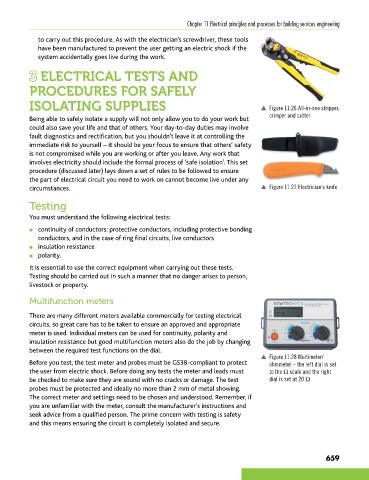
                between the required test functions on the dial.
                                                                                           p  Figure 11.28 Multimeter/
                Before you test, the test meter and probes must be GS38-compliant to protect   ohmmeter – the left dial is set
                the user from electric shock. Before doing any tests the meter and leads must   to the Ω scale and the right
                be checked to make sure they are sound with no cracks or damage. The test     dial is set at 20 Ω
                probes must be protected and ideally no more than 2 mm of metal showing.
                The correct meter and settings need to be chosen and understood. Remember, if
                you are unfamiliar with the meter, consult the manufacturer’s instructions and
                seek advice from a qualified person. The prime concern with testing is safety
                and this means ensuring the circuit is completely isolated and secure.


                                                                                                                659


        9781510416482.indb   659                                                                                    29/03/19   9:09 PM

