


Page 675 - The City and Guilds Textbook: Plumbing Book 1 for the Level 3 Apprenticeship (9189), Level 2 Technical Certificate (8202) and Level 2 Diploma (6035)
P. 675
Chapter 11 Electrical principles and processes for building services engineering

                You will be involved with isolating the circuit to complete works for two
                main reasons. You may be asked to remove an appliance from a plug,
                which is the easiest method of isolation. You might be asked to isolate an
                immersion heater from a fused connection unit in order to repair, replace or
                decommission an electrical shower. Failure to isolate supplies correctly can
                result in electric shock.

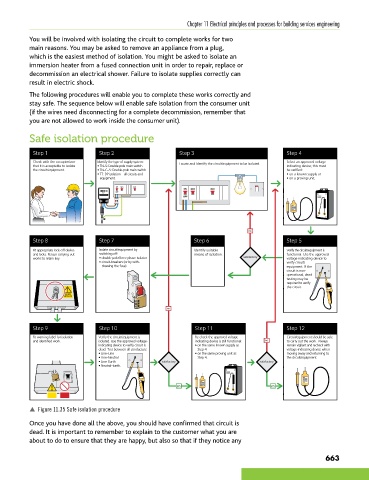
                The following procedures will enable you to complete these works correctly and
                stay safe. The sequence below will enable safe isolation from the consumer unit
                (if the wires need disconnecting for a complete decommission, remember that
                you are not allowed to work inside the consumer unit).

                Safe isolation procedure


                 Step 1               Step 2                    Step 3                             Step 4
                 Check with the occupier/user  Identify the type of supply system:  Locate and identify the circuit/equipment to be isolated.   Select an approved voltage-
                 that it is acceptable to isolate  • TN–S: Double-pole main switch                 indicating device; this must
                 the circuit/equipment.  • TN–C–S: Double-pole main switch                         be verified:
                                      • TT: DP isolation – all circuits and                        • on a known supply or
                                         equipment.                                                • on a proving unit.


                                                                                       no
                 Step 8               Step 7                         Step 6                        Step 5

                 Fit appropriate lock-off device  Isolate circuit/equipment by  Identify suitable  Verify the circuit/equipment is
                 and locks. Person carrying out  switching off:      means of isolation.           functional. Use the approved
                 works to retain key.  • double-pole/three-phase isolator            satisfactory  voltage-indicating device to
                                      • circuit-breakers (or by with-                              verify circuit/
                                         drawing the fuse).                                        equipment. If the
                                                                                                   circuit is non-
                                                                                                   operational, dead
                                                                                                   testing may be
                                                                                                   required to verify
                                                                                                   the circuit.
                                                            no


                 Step 9               Step 10                        Step 11                       Step 12
                 Fit warning label for isolation  Verify the circuit/equipment is  Re-check the approved voltage-  Circuit/equipment should be safe
                 and identified work.  isolated. Use the approved voltage-  indicating device is still functional:  no  to carry out the work. Always
                                      indicating device to verify circuit is  • on the same known supply as  remain vigilant and recheck with
                                      dead. Test between all conductors:     Step 4                voltage-indicating device when
                                      • Line–Line                    • on the same proving unit as  moving away and returning to
                                      • Line–Neutral                    Step 4.                    the circuit/equipment.
                                      • Line–Earth         satisfactory                   satisfactory
                                      • Neutral–Earth.

                                                                yes                           yes


                p  Figure 11.35 Safe isolation procedure

                Once you have done all the above, you should have confirmed that circuit is
                dead. It is important to remember to explain to the customer what you are
                about to do to ensure that they are happy, but also so that if they notice any

                                                                                                                663


        9781510416482_Ch11.indd   663                                                                               01/04/19   9:39 PM

