


Page 79 - The City and Guilds Textbook: Plumbing Book 1 for the Level 3 Apprenticeship (9189), Level 2 Technical Certificate (8202) and Level 2 Diploma (6035)
P. 79
Chapter 1 Health and safety practices and systems

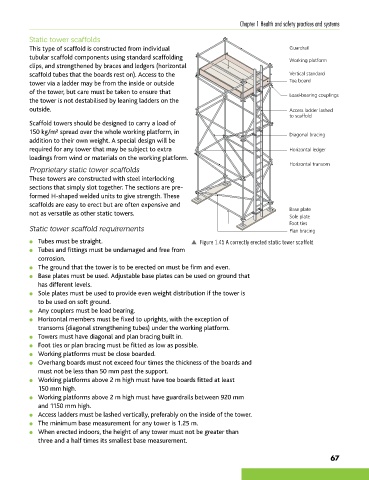
                Static tower scaffolds
                This type of scaffold is constructed from individual                                Guardrail
                tubular scaffold components using standard scaffolding
                                                                                                    Working platform
                clips, and strengthened by braces and ledgers (horizontal
                scaffold tubes that the boards rest on). Access to the                              Vertical standard
                tower via a ladder may be from the inside or outside                                Toe board
                of the tower, but care must be taken to ensure that
                                                                                                    Load-bearing couplings
                the tower is not destabilised by leaning ladders on the
                outside.                                                                            Access ladder lashed
                                                                                                    to scaffold
                Scaffold towers should be designed to carry a load of
                150 kg/m² spread over the whole working platform, in
                                                                                                    Diagonal bracing
                addition to their own weight. A special design will be
                required for any tower that may be subject to extra                                 Horizontal ledger
                loadings from wind or materials on the working platform.
                                                                                                    Horizontal transom
                Proprietary static tower scaffolds
                These towers are constructed with steel interlocking
                sections that simply slot together. The sections are pre-
                formed H-shaped welded units to give strength. These
                scaffolds are easy to erect but are often expensive and
                not as versatile as other static towers.                                            Base plate
                                                                                                    Sole plate
                                                                                                    Foot ties
                Static tower scaffold requirements                                                  Plan bracing
                ●  Tubes must be straight.                          p  Figure 1.45 A correctly erected static tower scaffold
                ●  Tubes and fittings must be undamaged and free from
                   corrosion.
                ●  The ground that the tower is to be erected on must be firm and even.
                ●  Base plates must be used. Adjustable base plates can be used on ground that
                   has different levels.
                ●  Sole plates must be used to provide even weight distribution if the tower is
                   to be used on soft ground.
                ●  Any couplers must be load bearing.
                ●  Horizontal members must be fixed to uprights, with the exception of
                   transoms (diagonal strengthening tubes) under the working platform.
                ●  Towers must have diagonal and plan bracing built in.
                ●  Foot ties or plan bracing must be fitted as low as possible.
                ●  Working platforms must be close boarded.
                ●  Overhang boards must not exceed four times the thickness of the boards and
                   must not be less than 50 mm past the support.
                ●  Working platforms above 2 m high must have toe boards fitted at least
                   150 mm high.
                ●  Working platforms above 2 m high must have guardrails between 920 mm
                   and 1150 mm high.
                ●  Access ladders must be lashed vertically, preferably on the inside of the tower.
                ●  The minimum base measurement for any tower is 1.25 m.
                ●  When erected indoors, the height of any tower must not be greater than
                   three and a half times its smallest base measurement.

                                                                                                                 67


        9781510416482.indb   67                                                                                     29/03/19   8:50 PM

