


Page 115 - APPLIED PROCESS DESIGN FOR CHEMICAL AND PETROCHEMICAL PLANTS, Volume 1, 3rd Edition
P. 115
Fluid Flow                                            99

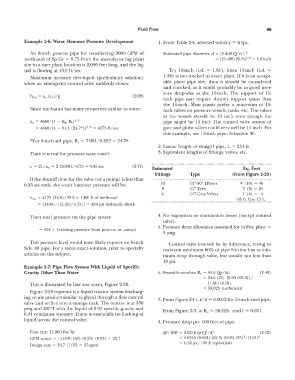
           Example 2-6: Water Hammer Pressure  Development          1. From Table 2-4,  selected velocity =  6 fps.

              An  8-inch  process  pipe  for  transferring  2000  GPM  of   Estimated pipe diameter,  d  =  (0.408 Q!v)  112
                                                                                                          2
           methanol of Sp Gr =  0.75 from the manufacturing plant                           =  [ (0.4.-08) 25/6] 11 =  1.3 inch
           site to a user plant location is 2,000 feet long,  and the liq-
           uid is flowing at 10.8 ft/  sec.                             Try  l�inch  (i.d.  =  1.61),  since  lX-inch  (i.d.  =
              Maximum  pressure  developed  (preliminary  solution)   1.38)  is not stocked in every plant.  If it is an accept-
           when an  emergency control valve suddenly closes:          able  plant pipe  size,  then  it should  be  considered
                                                                      and checked,  as  it would probably be  as  good pres-
                                                                      sure  drop-wise  as  the  lY,-inch.  The  support  of lX-
                                                         (2-69)
                                                                      inch  pipe  may  require  shorter support spans  than
                                                                      the  lY,-inch.  Most  plants  prefer  a  minimum  of  l�
              Since methanol  has many properties similar to water:   inch valves on pressure vessels,  tanks,  etc. The valves
                                                                      at  the  vessels  should  be  11.!  inch  even  though  the
                                1 2
              aw  = 4660/  (I  +  Ki,, Br)  1                         pipe  might be  IX  inch The  control  valve  system  of
                =  4660/(1-:--  0.01  (24.7"')] 112  = 4175 ft/sec    gate and globe valves could very well be  iX inch.  For
                                                                      this example,  use  lY,-inch pipe, Schedule 40:
              "For 8-inch std pipe, Br= 7.981/0.322  =  24.78
                                                                   2.  Linear length of straight pipe,  L =  254 ft.
              Time interval for pressure wave travel:              3.  Equivalent lengths of fittings, valves,  etc.

              ts= 2L/aw  =  2  (2000)/4175  = 0.95 sec   (2-71)
                                                                 Estimated                             Eq. Feet
                                                                  Fittings       Type              (from Figure 2-20)
              If the shutoff time for the valve  (or a pump)  is less than
           0.95 seconds,  the water hammer pressure will be:         10          lW'-90°  Elbows      4' (10)  =  40
                                                                     8           L;,5"-Tees            3' (8)  =  24
                                                                     4           l W'-Gale Valves      l '  (4)  =  4
              h" 11  =  4175  ( 10.8) /32.2  =  1400 ft of methanol                                  68 ft.  Use 75 ft.
                                                                 �============��==�==��=====�
                 =  (1400)/((2.�\l)/0.75)]  =  454 psi hydraulic shock

              Then total pressure on the pipe system               4.  No  expansion  or contraction  losses  ( except control
                                                                      valve).
                                                                   5.  Pressure drop allowance assumed for orifice plate  =
                  =  454 +  (existing pressure from process/or pump)
                                                                     5 psig.
              This pressure level would most likely rupture  an 8-inch   Control  valve  loss will  be  by  difference,  trying  to
           Sch.  40 pipe.  For a  more exact solution, refer to specialty   maintain minimum 60% of pipe friction loss  as min-
           articles on  the subject.                                  imum  drop through valve, but usually  not less  than
                                                                      10 psi.
           Example 2-7: Pipe flow System With Liquid of Specific
           Gravity Other Than Water                                6.  Reynolds number,  R.,  =  50.6 Qp/dµ   (2-49)
                                                                                      ==  so.e  (25)  [0.93  (62.3)]/
             This is illustrated by line size sheet,  Figure 2-28.                      (1.61)  (0.91)
                                                                                      =  50,025  (turbulent)
              Figure 2-29 represents a  liquid reactor system discharg-
           ing crude product similar to glycol through a flow control   7.  From Figure 2-11, £/d = 0.0012 for lY,-inch steel pipe.
           valve and orifice into a storage tank.  The reactor is at 350
           psig and 280°F with the liquid of 0.93 specific gravity and   From Figure 2-3, at R,,  =  50,025, read f =  0.021
           0.91  centipoise viscosity.  There is essentially no flashing of
           liquid across the control valve.
                                                                   8.  Pressure drop per 100 feet of  pipe:
             Flow rate:  11,000 lbs/hr                               �P/100' =  0.0216 fp  Q /d 5             (2-72)
                                                                                        2
                                                                                                       2
              GPM  actual= 11,000/(60)  (8.33)  (0.93)  =  23.7             =  0.0216 (0.021)  (62.3)  (0.93)  (25) /(1.61) 5
                                                                            =  1.52 psi/  100 ft  equivalent
              Design rate  =  23.7  (1.05)  =  25 gpm

