


Page 117 - APPLIED PROCESS DESIGN FOR CHEMICAL AND PETROCHEMICAL PLANTS, Volume 1, 3rd Edition
P. 117
Fluid Flow                                           101
                 ,-u---        Vo Ive  Valve  Valve              a  piping  or  process  system,  there  may  be  ( 1)  adiabatic
                                     Flaw
                     Orifice
                               Gate  Control  Gale
                                                                 Dow where for practical purposes there is no exchange of
                      Plate
                                                                 heal into or from the pipe.  This is expressed by:
                 *Gale
            ------    Valve         Globe                          P' V/  =  constant (adiabatic)             (2-73)
                                    Valve
               Dip,
              Pipe I
           Reactor Ill 350 psig             Crude  Product  Storage   or,  (2)  isothermal flow,  which is flow at constant tempera-
                                            Tank  at Atmospheric   ture  ( often close  to practical experience)  and:
                                             Pressure

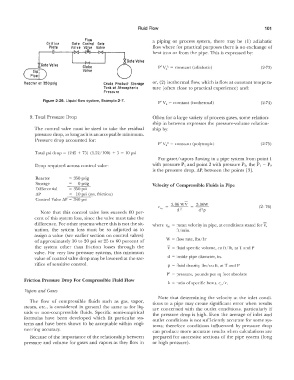
                   Figure 2-29.  Liquid flow system,  Example 2-7.
                                                                   P' Va= constant (isothermal)               (2-74)

              9.  Total Pressure Drop                            Often for a  large variety of process gases,  some relation-
                                                                 ship in between expresses  the pressure-volume relation-
               The  control  valve  must be  sized  to  take  the  residual   ship by:
                pressure drop,  as long as it is an acceptable minimum.
                Pressure drop accounted for:
                                                                   P' Va"  =  constant (polytropic)           (2-75)

                Total  psi drop= (245  +  75)  (1.52/100)  +  5  =  10 psi
                                                                   For gases/vapors flowing in a  pipe system from point 1
                Drop required across control valve:              with pressure P 1  and point 2 with pressure P 2,  the P 1  - P 2
                                                                 is the pressure drop,  �P,  between  the points  [3].
                Reactor       =  350 psig
                Storage           O  psig                        Velocity of Compressible Fluids in Pipe
                Differential   =  350 psi
                6.P           =  10 psi  (sys. friction)
                Control  Valve L'.P  =  340 psi
                                                                         3.06 WV   3.06\,\1                  (2- 76)
                                                                           d ?      d2p
                  Note  that  this  control  valve  loss  exceeds  60  per-
                cent of this system  loss,  since the valve must take the
                difference.  For-  other systems where this is not the sit-   where  vm  =  mean velocity in pipe, at conditions stated for V,
                uation,  the  system  loss  must  be  so  adjusted  as  to   ft/min.
                assign  a value  (see earlier section on  control valves)
                of approximately  10 to 20 psi  or 25  to 60  percent of   \V  =  flow rate,  lbs/hr
                the  system  other  than  friction  losses  through  the   V  =  fluid specific volume, cu ft/lb,  at T and P
               valve.  For very  low  pressure  systems,  this  minimum
                value of control valve drop may be lowered at the sac-   d  =  inside pipe diameter,  in.
                rifice of sensitive control.                           p  =  fluid density,  lbs/ cu ft,  at T and P

                                                                       P' =  pressure,  pounds per sq foot absolute
           Friction Pressure Drop For Compressible Fluid Flow
                                                                       k  =  ratio of specific heats,  cp/c"
           Vapors  and Gases
                                                                   Note  that determining  the  velocity  at the  inlet condi-
             The  flow  of  compressible  fluids  such  as  gas,  vapor,   tions  to  a  pipe  may  create  significant error when  results
           steam,  etc.,  is  considered  in  general  the same  as  for liq-   are  concerned  with  the  outlet  conditions,  particularly  if
           uids  or  non-compressible  fluids.  Specific  semi-empirical   the  pressure  drop  is  high.  Even  the  average  of inlet and
           formulas  have  been  developed  which  fit  particular  sys-   outlet conditions is not sufficiently accurate for some sys-
           tems  and  have  been shown  to  be  acceptable within  engi-   tems;  therefore  conditions  influenced  by  pressure  drop
           neering accuracy.                                     can  produce more accurate  results when calculations are
              Because of the importance of the relationship between   prepared for successive sections of the pipe system  (long
           pressure  and volume for gases  and vapors  as  they flow  in   or high pressure).

