


Page 114 - APPLIED PROCESS DESIGN FOR CHEMICAL AND PETROCHEMICAL PLANTS, Volume 1, 3rd Edition
P. 114
98                        Applied Process Design for Chemical  and Petrochemical  Plants

                                                                     The pressure that can develop from the shock wave can
                                                                  be destructive  to  the containing system  hardware,  partic-
                                                                  ularly in long pipe. Examples of  conditions that can devel-
                                                          Tonk    op water hammer are:


                        125  feet                                    1. start,  stop,  or an abrupt change in a  pump's speed
                        Straight  pipe           90°  Elbow          2.  power failure
                                                 (Welding  Type)     3.  rapid  closing  of  a  valve  (usually  a  control  valve,
                                                                       which can slam shut in one or two seconds)

                         __ e" Gate  Valve                           The  magnitude  of this  shock wave  can  be  expressed
                           Full  Open                              [19,  20]:
             Suction
             Line
                    Centrifugal                                                                                (2-69)
                      Pump
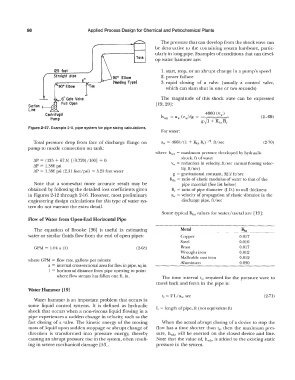
             Figure 2-27.  Example 2-5,  pipe system for pipe sizing calculations.
                                                                     For water:

               Total  pressure  drop from  face  of discharge  flange  on   a,.= 4660/(l + Ki,, Br)ll ft/sec    (2-70)
                                                                                         2,
             pump to nozzle connection on tank:
                                                                  where  h,..h  = maximum pressure developed by hydraulic
                                                                             shock,  ft of  water
               �p =  (125 + 67.5)  [(0.720)/100]  +  0                   v,..  = reduction in velocity,  ft/sec  (actual  flowing veloc-
               �p =  1.386 psi                                               ity,  ft/  sec)
               �p =  1.386 psi  (2.31  feet/  psi)  = 3.20 feet water
                                                                          g  = gravitational constant,  32.2 ft/sec
                                                                        Ki,,  = ratio of elastic modulus of  water to that of the
               Note  that  a  somewhat  more  accurate  result  may  be      pipe material  (See list below)
             obtained  by following the detailed loss  coefficients given   Br  =  ratio of pipe diameter (I.D.)  to wall thickness
             in Figures  2-12  through 2-16.  However,  most preliminary   a;  = velocity of propagation of elastic vibration in the
             engineering design  calculations for this type  of water sys-   discharge pipe, fl/sec
             tem do not warrant the extra detail.
                                                                     Some typical Ki,s values for water/metal are  [19]:
             Flow of  Water from Open-End Horizontal Pipe

               The  equation  of Brooke  [36]  is  useful  in  estimating    Metal                     Ki...
             water or similar fluids flow from the end of open pipes:        Copper                   0.017
                                                                             Steel                    0.010
               GPM  =  1.04 a  (1)                        (2-68)             Brass                    O.Ql7
                                                                             Wrought iron             0.012
                                                                             Malleable cast iron      0.012
             where  GPM  = flow rate,  gallons per minute                    Aluminum                 0.030
                     a =  internal cross-sectional area for flow in pipe, sq in.
                      I  =  horizontal distance from pipe opening to point
                         where flow stream has fallen one ft, in.    The time interval  t 5,  required for the pressure wave  to
                                                                   travel back and forth in the pipe is:
             Water Hammer [19]
                                                                     t,.  = 2  L/a,.,  sec                      (2-71)
               Water hammer is an important problem  that occurs in
             some  liquid  control  systems.  It  is  defined  as  hydraulic   L  = length of pipe, ft  (not equivalent ft)
             shock that occurs when a non-viscous liquid flowing in a
             pipe experiences a sudden change in velocity,  such as the
             fast closing of a valve.  The kinetic  energy of the  moving   When the actual  abrupt closing of a device to stop the
             mass of liquid upon sudden stoppage or abrupt change of   flow has  a time shorter than  ts,  then  the maximum  pres-
             direction  is  transformed  into  pressure  energy,  thereby   sure,  hwh,  will  be  exerted  on  the  closed  device and  line.
             causing an abrupt pressure rise in the system, often result-   Note  that the value of,  hwh•  is added  to the existing static
             ing in severe mechanical damage  [53].                pressure in the system.

