


Page 251 - APPLIED PROCESS DESIGN FOR CHEMICAL AND PETROCHEMICAL PLANTS, Volume 1, 3rd Edition
P. 251
Pumping of Liquids                                       221

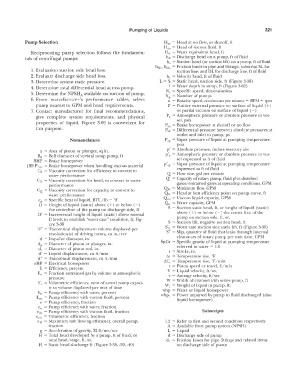
            Pump Selection                                            H, =  Head at no flow,  or shutoff,  ft
                                                                        0
                                                                      I-I"' = Head of viscous fluid,  ft
              Reciprocating  pump  selection  follows  the  fundamen-   H; = Water equivalent head,  fl
            tals of centrifugal  pumps:                                hd  =  Discharge  head on a pnmp,  ft  of fluid
                                                                       h,  =  Suction head  ( or suction lift)  on a pump, ft of fluid
                                                                  hsL,  huL  =  Friction losses in pipe and fiuings., subscript SL for
              1. Evaluation suction side head loss.                        suction line;  and DL for discharge line, ft �f fluid
              2.  Evaluate discharge  side head loss.                  h,  = Velocity head, ft of fluid
              3.  Determine system  static pressure.                L  =  S  =  Static  head, suction side,  ft  (Figure  3-38)
              4.  Determine total  differential  head across pump.      I  =  Water depth in sump,  ft  (Figure 3-62)
                                                                       N,  =  Specific speed, dimensionless
              5.  Determine the NPSHA available on suction of pump.   NP  =  Number of pumps
              6.  From  manufacturer's  performance  tables,  select   n  =  Ro �� ve speed, revolutions per minute = RP;\1  =  rpm
                pump nearest to GPM and head requirements.             P  =  Positive  external  pressure  on surface of liquid  ( +)
              7.  Contact  manufacturer  for  final  recommendations  ,    or partial vacuum on surface of liquid  ( - )
                give  complete  system  requirements,  and  physical   Pa  =  Atmospheric  pressure or absolute pressure in ves-
                                                                           sel,  psia
                properties  of liquid.  Figure  3-69  is  convenient  for   Pso  =  Brake horsepower at shutoff or no flow
                this purpose.                                         P,d  =  Differential  pressure between absolute pressures at
                                                                           outlet and inlet to  pump,  psi
                              Nomenclature                            P,.,  =  Vapor pressure of liquid at pumping temperature,
                                                                           ps1a
                  a  =  Area of piston or plunger;  sq in.             p'  = Absolute pressure,  inches mercury abs
                 Bct  =  Bell diameter of vertical sump pump,  ft     p',  =  Atmospheric pressure or absolute  pressure  in ves-
               BHP  =  Brake horsepower                                    sel expressed as ft of fluid
            (BHP)v,s  =  Brake horsepower when handling viscous material   p'vp  =  Vapor pressure of liquid at pumping temperature
                 CE  = Viscosity  correction for efficiency to convert to   expressed as ft of fluid
                     water performance                                 Q  =  Flow  rate, gal  per minute
                 CH  =  Viscosity  correction for head,  to convert Lo water   Q'  =  Capacity of rotary pump, fluid plus dissolved
                      performance                                          gases/  entrained gases at operating conditions,  GPM
                 CQ  = Viscosity correction for capacity,  Lo  convert to   Q�r  =  Minimum flow,  GPM
                     water performance                                QN  =  Head at best efficiency point on pump curve, ft
                 cp  =  Specific heat of liquid,  BTU/lb  - °F        Qm  = Viscous liquid capacity,  GPM
                  D  =  Height of liquid  (static)  above  ( +)  or below  (-)   Qw  =  Water capacity,  GP'.\1
                      the centerline of the pump on discharge side,  ft   S  =  Suction static head, ft, or height of liquid  (static)
                 D'  =  Incremental  height of liquid  (static)  above normal   above  ( +)  or below  (-)  the center line of the
                      D  level, to  establish  "worst case" condition  fr  Fig-   pump  on suction side. fL,  or,
                     i:re 3-38                         '  '   '         S  = Suction lift,  negative suction head, ft
                 D"  =  Theoretical  displacement volume displaced per   S'  L  = Worst case suction side static lift, ft  (Figure 3-39)
                      revo lutionrs)  of driving rotors, cu in./rev    S"  =  Slip,  quantity of fluid  that leaks  through internal
                  d  =  Impeller diameter,  in.                            clearances of rotary pump per unit time, GPM
                 dp  =  Diameter of piston or plunger,  in.         SpGr  =  Specific gravity of liquid at pumping temperature
                                                                           referred Lo water =  1.0
                 d,  =  Diameter of piston rod, in.                     s  =  Stroke,  in.
                 d'  =  Liquid displacement,  cu ft/min
                 d"  = Theoretical  displacement,  cu ft/min           1h  =  Temperature rise,  °F
               eHP  =  Electrical  horsepower                         t.T,  = Temperature rise, °F/min
                                                                        t  =  Piston speed or travel, fl/min
                  E  =  Efficiency,  percent                           V  =  Liquid velocity,  ft/sec
                 En  =  Fraction entrained gas by volume al atmospheric   v  =  Average velocity,  ft/sec
                      pressure                                         W  =  Width  of channel with series  pumo  ft
                 E,  =  Volumetric efficiency,  ratio of actual  pump capaci-   W1  =  Weight of liquid  in  pump,  lb   r :
                      L;-  to volume displaced per unit of time
                 Ew  =  Pump efficiency with water,  percent         whp  =  Water or liquid horsepower
                Evis  =  Pump efficiency with viscous  fluid, percent   whp.  =  Power imparted by pump Lo fluid discharged  (also
                                                                           iiquid horsepower)
                  e  =  Pump efficiency,  fraction
                 e.,  =  Pump efficiency with water,  fraction
                 evis  =  Pump efficiency with viscous fluid,  fraction               Subscripts
                e, 01  =  Volumetric efficiency,  fraction
                 e\ 1  =  Maximum safe  flowing efficiency,  overall  pump,   1,2  =  Refer to first and second condition respectively
                     fraction                                          A  = Available from  pump system  (NPSH)
                  g  = Acceleration of gravity,  32 ft/sec/sec         L  =  Liquid
                 H  = Total head developed by  a  pump,  fl of !1uid; or   cl  =  Discharge side  of pump
                     total  head/stage,  ft,  01�                      d,  =  Friction losses for pipe fittings  and related items
                 H  =  Static  head  discharge  ft  (Figure  3-38, -39, -40)   on discharge  side of pump

