


Page 258 - APPLIED PROCESS DESIGN FOR CHEMICAL AND PETROCHEMICAL PLANTS, Volume 1, 3rd Edition
P. 258
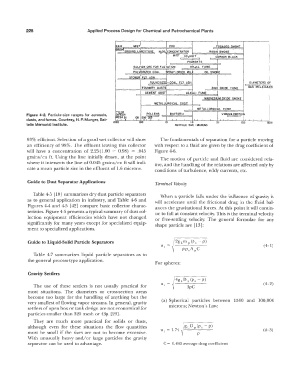
228                       Applied Process Design for Chemical and Petrochemical  Plants


                                                   AIN   .MIST                             � DSMOKE
                                                      GROUND  LIMESTONE                  ROSIN  SMOKE


                                                                                                 =

                                                                                                        c  __ DIAMETERS  OF
                                                                                                              -------
                                                                                                         GAS  MOLECULES
                                                                               ALKALI  FUM
                                                                             DUST
                                                                                    METALLURGICAL  FUME
                                                  TYLER
                                                                                              VIRUS S PROTEIN
                                                                         ACT  ER IA
            Figure  4-2.  Particle-size  ranges  for aerosols,   h � S H_3 5  ��� ...L...L;,!!,_ILL....l'---L � ,J;-.L....,__-L.... � '----.-);-.L...l.---'- � -L----;; � -'--c � - :- : � -=c, , � 1 ,.---- �� __j_
                                                   Ei
            dusts, and fumes. Courtesy,  H. P.  Munger,  Bat-   1000             �                     �
            telle Memorial Institute.                                      PARTICLE  SIZE - MCRONS
            93%  efficient.  Selection of a good wet collector will  show   The fundamentals of separation for a  particle  moving
            an  efficiency  of 98%.  The  effluent leaving  this  collector   with respect to a fluid are given by the drag coefficient of
            will  have  a  concentration  of 2.25 (1.00  -  0.98)  =  .045   Figure 4-6.
            grains/  cu  ft.  Using  the  line  initially  drawn,  at  the  point   The motion  of particle  and fluid are  considered rela-
            where  it intersects  the line of 0.045  grains/  cu  ft will indi-   tive, and the handling of the relations are affected only by
             cate a mean particle size in the effluent of 1.6 microns.   conditions of turbulence,  eddy currents,  etc.

             Guide to Dust Separator Applications                 Terminal Velocity

               Table 4-5  [10]  summarizes dry dust particle separators   When  a  particle falls  under the influence of gravity  it
             as  to  general  application  in  industry,  and Table  4-6  and   will  accelerate  until  the  frictional  drag  in  the  fluid  bal-
             Figures 44 and  4-5  [ 42]  compare  basic  collector charac-   ances  the gravitational forces.  At this point it will  contin-
             teristics.  Figure 4-5 presents a typical summary of  dust col-   ue to fall at constant velocity.  This is the terminal velocity
             lection  equipment  efficiencies  which  have  not  changed   or  free-settling  velocity.  The  general  formulae  for  any
             significantly for many years  except for specialized equip-   shape particle are  [13]:
             ment to specialized applications.

             Guide to Liquid-Solid Particle Separators
                                                                                                                (4-1)
               Table  4-7  summarizes  liquid  particle  separators  as  to
             the general  process-type application.
                                                                  For spheres:
             Gravity Settlers

                                                                                                                (4- 2)
               The  use  of these  settlers  is  not  usually  practical  for
             most  situations.  The  diameters  or  cross-section  areas
             become  too  large  for  the  handling  of anything  but the
             very smallest of flowing vapor streams.  In general,  gravity   (a)  Spherical  particles  between  1500  and  100,000
             settlers of  open box or tank design are not economical for   microns;  Newton's Law:
             particles smaller than 325 mesh or 43µ  [23].
               They  are  much  more  practical  for  solids  or  dusts,
             although  even  for  these  situations  the  flow  quantities
             must  be  small  if the  sizes  are  not  to  become  excessive.                                   (4- 3)
             With  unusually  heavy  and/or  large  particles  the  gravity
             separator can be used  to advantage.                     C =  0.445 average drag coefficient

