


Page 263 - APPLIED PROCESS DESIGN FOR CHEMICAL AND PETROCHEMICAL PLANTS, Volume 1, 3rd Edition
P. 263
Mechanical  Separations                                    233


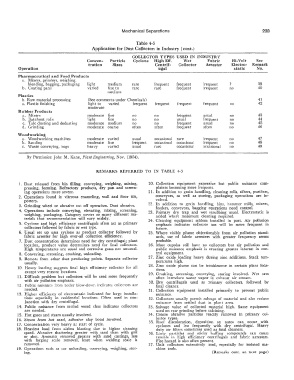
                                                          Table 4-5
                                        Application for Dust Collectors in Industry  (cont.)
                                                        COLLECTOR  TYPES  USED  IN  INDUSTRY
                                      Concen-   Particle   Cyclone   High Eff.   Wet    Fabric    Hi-Volt   See
                                      tration   Sizes             Centrlf-   Collector   Arrester   Electro-   Remark
         Operation                                                 ugal                            static   No.
         Pharrnaceu tical and  Food Products
          "-•  Mixers,  grinders,  weighing,
             blending, bagging, packaging   light   medium   rare   frequent   frequent   frequent           39
           b.  Coating  pans          varied   fine  to   rare    rare     frequent   frequent   no          40
                                              medium
         Plastics
          b.  Raw  material processing   (See comments under Chemicals)                                      41
          a.  Plastic finishing       light to   varied   frequent   frequent   frequent   frequent   no     42
                                      moderate
         Rubber Products
           o..  Mixers                moderate  fine    no        no       frequent   usual      no          43
           b.  Batchout rolls         light   fine      no        no       usual      frequent   no          44
           c.  Talc dusting and dedusting   moderate  medium   no   no     frequent   usual      no          45
           d.  Grinding               moderate  coarse   often    often    frequent   often      no          46
         Woodworking
           c .  'Woodworking  rnachiues   moderate  varied   usual   occasional  rare   frequent   no        47
           b.  Sanding                moderate  fine    frequent   occasional  occasional   frequent   no    48
           c.  Waste conveying,  hogs   heavy   varied   usual    rare     occasional   occasional   no      49
            By  Permission John  M.  Kane,  Plant Engineering,  Nov.  (1954).


                                         REMARKS  REFERRED  TO  IN  TABLE  4-5

         I.  Dust  released  from  bin  filling,  conveying,  weighing,  mixing,   20.  Collection  equipment  expensive  but  public  nuisance  com-
           pressing,  forming.  Refractory  products,  dry  pan  and  screen-   plaints  becoming more  frequent.
            ing  operations  more  severe.                     21.  In  addition  to  grain  handling,  cleaning  rolls,  sifters,  purifiers,
         2.  Operations  found  in  vitreous  enameling,  wall  and  floor  tile,   conveyors,  as  well  as  storing,  packaging  operations  are  in-
           pottery.                                               volved.
         3.  Grinding  wheel  or  abrasive  cut  off  operation.  Dust  abrasive.   22.  In  addition  to  grain  handling,  bins,  hammer  mills,  mixers,
                                                                  feeders,  conveyors,  bagging  operations  need  control.
         4.  Operations  include  conveying,  elevating,  mixing,  screening,   23.  Primary  dry  trap  and  wet  scrubbing  usual.  Electrostatic  is
           weighing,  packaging.  Category  covers  so  many  different  ma-   added  where  maximum  cleaning  required.
            terials  that  recommendation  will  vary  widely.   24.  Cleaning  equipment  seldom  installed  in  past.  Air  pollution
         5.  Cyclone  and  high  efficiency  centrifugals  often  act as  primary   emphasis  indicates  collector  use  will  be  more  frequent  in
            collectors followed by fabric or wet type.            future.
         6.  Usual  set  up  uses  cyclone  as  product  collector  followed  by   25.  Where  visible  plume  objectionable  from  air  pollution  stand-
           fabric  arrester  for  high  over-all  collection  efficiency.   ards,  use  of  fabric  arresters  with  greater  frequency  seems
         7.  Dust  concentration  determines  need  for dry  centrifugal;  plant   probable.
           location,  product  value  determines  need  for  final  collectors.   26.  Most  cupolas  still  have  no  collectors  but  air  pollution  and
           High  temperatures  are  usual  and  corrosive  gases  not  unusual.   public  nuisance  emphasis  is  creating  greater  interest  in  con-
         8.  Conveying,  screening,  crushing,  unloading.        trol  equipment.
         9.  Remote  from  other  dust  producing  points.  Separate  collector   27.  Zinc  oxide  loading  heavy  during  zinc  additions.  Stack  tem-
            usually.                                              peratures  high.
         10.  Heavy  loading  suggests  final  high  efficiency  collector  for  all   28.  Zinc  oxide  plume  can  be  troublesome  in  certain  plant  loca-
            except very remote  locations.                        tions.
         11.  Difficult  problem  but collectors  will  be  used  more  frequently   29.  Crushing,  screening,  conveying,  storing  involved.  Wet  ores
                                                                  often  introduce  water  vapor  in  exhaust  air  stream.
           with air pollution  emphasis.                       30.  Dry  centrifugals  used  as  primary  collectors,  followed  by
         12.  Public  nuisance  from  boiler  blow-down  indicates  collectors  are   final  cleaner.
            needed.                                            31.  Collection  equipment  installed  primarily  to  prevent  public
         13.  Higher  efficiency  of  electrostatic  indicated  for  large  installa-   nuisance.
           tions  especially  in  residential  locations.  Often  used  in  con-   32.  Collectors  usually  permit  salvage  of  material  and  also  reduce
            junction  with  dry  centrifugal.                     nuisance  from  settled  dust  in  plant  area.
         14.  Public  nuisance  from  settled  wood  char  indicates  collectors   33.  Salvage  value  of  collected  material  high.  Same  equipment
            are  needed.                                          used on  raw grinding before calcining.
         15.  Hot gases  and steam usually involved.           34.  Coarse  abrasive  particles  readily  removed  in  primary  col-
                                                                  lector  types.
        16.  Steam  from  hot  sand,  adhesive  clay  bond  involved.   35.  Roof  discoloration,  deposition  on  autos  can  occur  with
         17.  Concentration  very  heavy  at  start  of  cycle.   cyclones  and  less  frequently  with  dry  centrifugal.  Heavy
        18.  Heaviest  load  from  airless  blasting  due  to  higher  cleaning   duty  air  filters  sometimes  used  as  final  cleaners.
           speed.  Abrasive  shattering  greater  with  sand  than  with  grit   36.  Linty  particles  and  sticky  buffing  compounds  can  cause
           or  shot.  Amounts  removed  greater  with  sand  castings,  less   trouble  in  high  efficiency  centrifugals  and  fabric  arresters.
           with  forging  scale  removal,  least  when  welding  scale  is   Fire  hazard  is  also often  present.
           removed.                                            37.  Unit  collectors  extensively  used,  especially  for  isolated  ma-
        19.  Operations  such  as  car  unloading,  conveying,  weighing,  stor-   chine  tools.
           ing.                                                                           (Remarks  cont.  on  next  page)

