


Page 265 - APPLIED PROCESS DESIGN FOR CHEMICAL AND PETROCHEMICAL PLANTS, Volume 1, 3rd Edition
P. 265
Mechanical  Separations                                    235

                                                          Table 4-7
                                       General Applications of Liquid  Particle  Separators


                                                                                    COLLECTOR  TYPES
                                                                         Impinge-                      I
         Operation                Concentration   Particle Sizes   Gravity   ment   Cyclone   Scrubbers   Electrical
         Pipeline entrained  liquid   light     fine to coarse   No      Frequent   Yes       Occasional   Few
         Compressor discharge  liquid   light   fine           No        Frequent   Occasional   Occasional   Rare
         Compressor oil  haze     very light    very  fine     No        Frequent   Frequent   Frequent   Occasional
         Flashing  liquid         light to mod.   fine to  medium   No   Frequent   Frequent   Occasional   Rare
         Boiling or bubbling      light to heavy   fine  to coarse   Occasional   Frequent   Frequent   Occasional   Rare
         Spraying                 light to  heavy   fine to coarse   No   Frequent   Frequent   Rare     Rare
         Corrosive liquid  particles   light to heavy   fine to coarse   Occasional   Frequent   Occasional   Frequent   Rare
         Liquid  plus solid particles   light to heavy   medium   Occasional   Occasional   Frequent   Frequent   I   Occasional


                100,000   '"
                          '�
                           I�                                                 Symbols  and  Legend
                             ��                                 Ap=  Area  of Particle  Projected  on  Plane  Normal  to
                                                                   Direction  of  Flow  or  Motion, sq.  fl.
                               "\                               c  =Overall  Drag  Coefficient,  Dimensionless
                 10,000  '  ""    "  ...                        Op  =Diameter  of Particle,  ft  .
               ...          '                                   Fd  =Drag  or Resistance  lo  Motion  of Body  in  Fluid,
                                    """  ��
              ct               <,  ,,                              Poundals
              i:-i
            ...  .....                  �                       NR,=Reynolds  Number, Dimensionless
            u,  N  ::,   1,000            "  ,,
              -�                     ' .     �                  u   =Relative  Velocity  Between  Particle  and  Main  Body
             II                        I''                         of Flu id  , ft./sec.
             -                             <,    �              p
             u                                I�                JJ,  = Fluid  Viscosity,  (lb.  mass) I  ( ftXsecJ = Centipoises  + 1488
             c:
             a,
             :�    100                              ,,            =Fluid  Density  ,(lb.mass)/(cu. ft.)
             :::::                              <,   r�            (Any  Consistent  System  of Units  may be  Employed  in
                                                                    Place  of the  English  Units  Specified l
             "'
             0
             u                                     <,   "'  �
             ...                                     1,   "I �
             Cl
             0
             Q      10                                                       --  Spheres
                                                            ......           ---    Disks
                                                               � ...  - �    --  Cylinders
                                                                    :,.,..._   --
                                                                     -ol:;.  .. � ==:- --  ..   -  --
                    1.0                                                                        -    _-:,.   '  -
                                                                                                       \ ..
                                                                                                        \   �
                    0.1
                     0.0001   0.001   0.01     0.1      1.0      10      100     1,000   10,000   100,000   1,000,000
                                                                         DpPU
                                                       Reynolds  Number , NRe  =  T
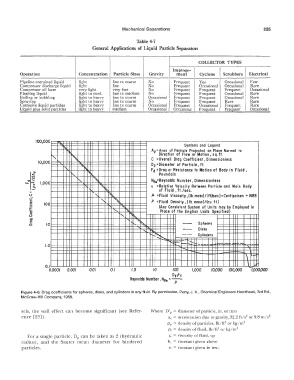
          Figure 4-6.  Drag coefficients for spheres, disks, and cylinders in any fluid. By permission, Perry,  J. H., Chemical  Engineers Handbook,  3rd Ed.,
          McGraw-H!ll Company,  1950.

          sels,  the  wall  effect  can  become  significant  (see  Refer-   Where  D'  P  = diameter of particle,  in. or mm
          ence  [231).                                                 a.,  = acceleration due to gravity,  32.2 ft/s or 9.8 m/s 2
                                                                                                       2
                                                                       Pp  =  density of particles,  lb/ft 3  or kg/rn3
                                                                       P1  =  density of fluid,  lb/ft3  01'  kg/rn 3
            For a  single  particle,  DP  can  be  taken as 2  (hydraulic   µ  =  viscosity  of fluid.  cp
          radius),  and  the  Sauter  mean  diameter  for  hindered    b ,  = constant given above
          particles.                                                   n  =  constant given in text.

