


Page 269 - APPLIED PROCESS DESIGN FOR CHEMICAL AND PETROCHEMICAL PLANTS, Volume 1, 3rd Edition
P. 269
Mechanical  Separations                                   239

           API-Oil Field Separators


             The American Petroleum Institute Manual on Disposal
           of  Refinery  Wastes  provides  specific  design  and  construc-
           tion  standards  for APl-separators  that are  often  used  in
           oilfield waste disposal  [24].

           Liquid/Liquid, Liquid/Solid Gravity Separations,
           Decanters, and Sedimentation Equipment

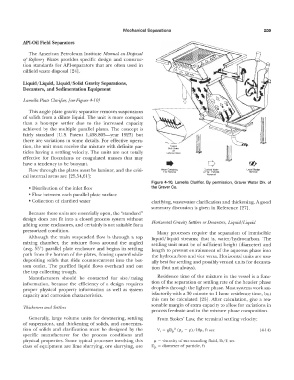
           Lamella Plate  Clarifier;  [see Figure  4-10]
             This angle plate gravity separator removes suspensions
           of solids from  a  dilute  liquid.  The  unit is  more  compact
           than  a  box-type  settler  due  to  the  increased  capacity
           achieved  by  the  multiple  parallel  plates.  The  concept  is
           fairly  standard  (U.S.  Patent  1,458.805-year  1923)  but
           there  are  variations  in  some  details.  For effective  opera-
           tion,  the unit must receive  the mixture with definite  par-   Bo1h Sides
                                                                        TyD!CaJ
                                                                         QI
           ticles  having  a  settling velocity  The  units  are  not  totally   ..
                                                                       Larnclta Prates
           effective  for  flocculants  or  coagulated  masses  that  may
           have a tendency to be buoyant.
             Flow  through  the plates must be laminar,  and the criti-   Wa.te•Conta111ng   w.Hoc  Particles   Loauld  Sludge
                                                                                       Cianhed  Water
                                                                                                         Bemcvat
                                                                     F'oc Parnc'es
           cal  internal  areas are  [25,54,61]:                                        Pcrroved
                                                                Figure  4-10.  Lamella  Clarifier.  By  permission,  Graver Water Div.  of
             • Distribution of the inlet flow                   the Graver Co.
             o  Flow between each parallel plate surface
             • Collection of clarified water                    clarifying, wastewater clarification and thickening. A good
                                                                summary discussion is given in Reference  [27].
             Because these units are essentially open, the "standard"
           design  does  not fit into  a  closed  process  system  without
           adding some enclosures, and certainly is not suitable for a   Horizontal Gravity  Settlers  or Decanters,  Liquid/Liquid
           pressurized  condition.                                 Many  processes  require  the  separation  of immiscible
             Although  the  main  suspended  flow  is  through  a  top   liquid/liquid  streams;  that  is,  water/hydrocarbon.  The
           mixing  chamber,  the  mixture  flows  around  the  angled   settling unit must be  of sufficient height  (diameter)  and
           (avg.  55°)  parallel  plate  enclosure and  begins  its  settling   length  to prevent entrainment of the aqueous phase  into
           path from the bottom of the plates,  flowing upward while   the hydrocarbon and vice versa.  Horizontal units are usu-
           depositing  solids  that slide  countercurrent into  the  bot-   ally best for settling and possibly vented units for decanta-
           tom  outlet.  The  purified  liquid  flows  overhead  and  out   tion  (but not always).
           the top collecting trough.
                                                                   Residence  time  of the mixture  in  the vessel  is a func-
             Manufacturers  should  be  contacted  for  size/rating
           information,  because  the  efficiency  of a  design  requires   tion of the separation or settling rate of the heavier phase
           proper  physical  property  information  as  well  as  system   droplets through the lighter phase.  Most systems work sat-
           capacity and corrosion characteristics.              isfactorily with  a 30 minute to  1  hour residence time,  but
                                                                this can  be  calculated  [26]. After calculation,  give  a  rea-
                                                                sonable margin of extra capacity  to allow for variations in
           Thickeners and Settlers
                                                                process feedrate and in the mixture  phase  composition.
             Generally,  large  volume  units  for dewatering,  settling   From Stokes' Law,  the terminal settiing velocity:
           of suspensions,  and  thickening of solids,  and concentra-
           tion  of solids  and  clarification  must be  designed  by  the   V,  =  gD/  (Pp  - p)/18µ,  ft sec   (4-14)
           specific  manufacturer  for  the  process  conditions  and
           physical  properties.  Some  typical  processes  involving this   µ  =  viscosity of surrounding fluid, lb/ft  sec
           class  of equipment are  lime  slurrying,  ore  slurrying,  ore   DP  = diameter of particle,  fl

