


Page 48 - APPLIED PROCESS DESIGN FOR CHEMICAL AND PETROCHEMICAL PLANTS, Volume 1, 3rd Edition
P. 48
Process Planning, Scheduling and Flowsheet Design                       33

               • RP4.l Uniform Face-to-Face Dimensions for Flanged   this conversion has been slow.  This is primarily due to the
                Control Valve Bodies                              fact that engineers are more familiar with the "more prac-
               • RP4.2 Standard Control Valve Manifold Designs    tical"  engineering units  and also  few  text books  using SI
               • S5.1  Instrumentation Flow Plan Symbols          units are available. The conversion in the industry is awk-
               • RP7. l Pneumatic Control Circuit Pressure Test   ward  and  confusing  because  there  is  no  "feel"  for  the
               • RP7.2 Color Code for Panel Tubing                practical  meaning of the SI terms.
               • RP8. l  Instrument Enclosures for Industrial  Environ-
                ments                                             System Design Pressures
               • RPI  2.1  Electrical  Instruments  in  Hazardous  Atmos-
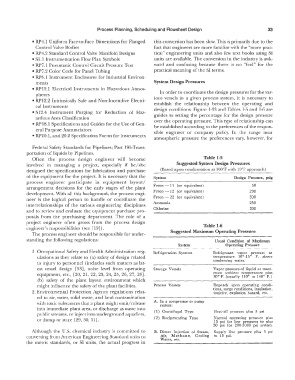
                pheres                                              In order to coordinate the design pressures for the var-
               • RP12.2  Intrinsically  Safe  and Non-Incendive  Electri-   ious  vessels  in  a  given  process  system,  it is  necessary  to
                cal  Instruments                                  establish  the  relationship  between  the  operating  and
               • Sl2.4  Instrument  Purging  for  Reduction  of  Haz-   design conditions.  Figure  1-33 and Tables  1-5 and 1-6 are
                ardous Area Classification                        guides  to  setting  the percentage  for the  design  pressure
                                                                  over the operating pressure. This type of relationship can
               • RP18.1  Specifications and Guides for the Use of Gen-   be established according to the preferences of the respon-
                eral Purpose Annunciators                         sible  engineer  or  company  policy.  In  the  range  near
               • RP20.l, and 20.2 Specification Forms for Instruments
                                                                  atmospheric  pressure  the  preferences  vary,  however,  for
               Federal  Safety  Standards  for Pipelines;  Part 195-Trans-
            portation of liquids by Pipelines.
               Often  the  process  design  engineer  will  become                     Table 1-5
            involved  in  managing  a  project,  especially  if  he/she    Suggested System Design Pressures
            designed  the  specifications  for fabrication  and  purchase   (Based upon condensation at l00°F with  10°F approach)
            of the equipment for the project.  It is  necessary  that the   System                  Design  Pressure,  psig
            process  engineer  participate  in  equipment  layout/
            arrangement decisions  for  the  early  stages  of the  plant   Freon-!!  (or  equivalent)     50
            development.  With all this background,  the process engi-   Freon-12  ( or  equivalent)      200
            neer  is  the  logical  person  to  handle  or  coordinate  the   Freon-  22  ( or  equivalent)   300
            interrelationships  of the  various  engineering  disciplines   Ammonia                       250
            and to review and evaluate the  equipment purchase pro-   Chlorine                            300
            posals  from  the  purchasing  department.  The  role  of a
            project  engineer  often  grows  from  the  process  design
            engineer's responsibilities  (see  fl9]).                                  Table  1-6
               The process engineer should be responsible for under-     Suggested Maximum Operating Pressure
            standing  the following regulations:                                            Usual  Condition  of  Maximum
                                                                            System              Operating  Pressure
               l. Occupational Safety and Health Administration reg-   Refrigeration  Systems   Refrigerant  vapor  pressure  at
                 ulations as  they relate  to  (a)  safety  of design related              temperature  10°-15°  F.  above
                 to  injury to  personnel  (includes such matters as  lat-                 condensing  water.
                 est  vessel  design  [53],  noise  level  from  operating   Storage  Vessels   Vapor pressure of  liquid  at maxi-
                 equipment,  etc.,  [20,  21, 22,  23,  24,  25,  26,  27,  28].           mum  ambient  temperature  plus
                                                                                           30° F.  ( usually  110°  to  140°  F.)
                 (b)  safety  of the  plant  layout  environment  which
                 might influence the safety of the plant facilities.   Process  Vessels    Depends  upon  operating  condi-
               2.  Environmental  Protection  Agency  regulations  relat-                  tions,  surge  conditions, insulation.
                                                                                           toxicity,  explosion  hazard,  etc.
                 ed  to air,  water,  solid waste,  and land contamination
                 with toxic substances that a plant might emit/release   A.  In  a  compressor or pump
                                                                    system:
                 into immediate  plant area,  or discharge as waste into
                 public streams, or inject into underground aquafiers,   ( 1)  Centrifugal  Type   Shut-off  pressure  plus  5  psi
                 or dump or store  [29, 30,  31].                 (2)  Reciprocating  Type   Normal  operating  pressure  plus
                                                                                           15  psi  for  low  pressures  to  plus
                                                                                           50  psi  for  200-3000  psi  system.
              Although  the  U.S.  chemical  industry  is  committed  to   B.  Direct  Injection  of  Steam,   Supply  line  pressure  plus  5  psi
            converting from American Engineering Standard units to   Air,  Methane,  Cooling   to  15  psi.
            the  metric  standards,  or SI  units,  the  actual  progress  in   Water,  etc.

