


Page 56 - APPLIED PROCESS DESIGN FOR CHEMICAL AND PETROCHEMICAL PLANTS, Volume 1, 3rd Edition
P. 56
Process Planning,  Scheduling and Flowsheet Design                     41


               28
                                                                    .-�  ...  c.....:.


                                                                                                      l'
                                                             .  h-
                                                                                                      -·
                                                                                                      -�-
                                                             '  �
                                                             ···-   4.


                12
                        +:
                                                       ·-
                                                 -:  -� , ....  zr l+�i=;:  �-  :+� ..
                8                                .      .  rec:...�+  _._..;..;  ...   . ::::  '-"-   -   +
                                        �-=tI!= flit tr:; :�ti� •- �  � -

                                  .   -.·r+i �   _:�f4,; .,-����I=  � +i �   :�H-;� �T:   M   -'--'--.
                                -r+t-'  -·�;.1-�.-:t:1i±L·±�_;  '  .   -ri-t:��  i-!1·
                                  1-  ....l-W  -  _-)!_l:  .Z:;_  .  !+,-  t�.:..  �1-1-;...1--f-+-r �·  -++
                                         -:-- ..;.  ..  ;-1,  '-i+i+  r:rl  '  .,  '   '   .   '
               0                               �m�lstl.�.!  ..  Mcm.  hNra  F,  •  ...,.nc1,  P•r  c  ...  t
                0.01   (l,0&  0.1  0.2   0.5   10   20   30   40   50   60   70   80   90   95   9B   99   99.5   99.8  99.9   "·"
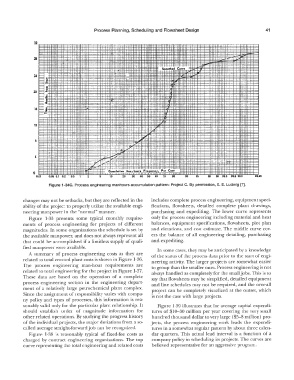
                      Figure  1-34C.  Process engineering manhours accumulation pattern:  Project C.  By pennission,  E.  E.  Ludwig [7].


           changes may not be setbacks, but they are reflected in the   includes complete process engineering,  equipment speci-
           ability of the project to properly utilize the available engi-   fications,  flowsheets,  detailed  complete  plant  drawings,
           neering manpower in the "normal" manner.              purchasing  and  expediting.  The  lower curve  represents
             Figure  1-35  presents  some  typical  monthly  require-   only the process engineering including material and heat
           ments  of  process  engineering  for  projects  of different   balances,  equipment specifications,  flowsheets,  plot plan
           magnitudes.  In some  organizations  the schedule is set by   and elevations,  and cost estimate.  The middle curve  cov-
           the available manpower,  and does not always represent all   ers  the  balance  of all  engineering  detailing,  purchasing
           that could be  accomplished  if a  limitless  supply of quali-   and expediting.
           fied  manpower were available.                          In some cases,  they may  be anticipated by a knowledge
             A  summary  of process  engineering  costs  as  they  are   of the status of the process data prior to the start of engi-
           related to total erected plant costs is shown in Figure 1-36.   neering activity.  The larger projects  are somewhat easier
           The  process  engineering  man-hour  requirements  are   to group than the smaller ones. Process engineering is not
           related to total engineering for the project in Figure  1-37.   always  handled as completely for the small jobs. This is to
           These  data  are  based  on  the  operation  of a  complete   say that flowsheets may  be simplified, detailed equipment
           process  engineering  section  in  the  engineering  depart-   and line schedules  may  not be  required,  and the  over-all
           ment of a  relatively large  petrochemical  plant complex.   project can be  completely  visualized at the  outset,  which
           Since  the assignment of responsibility varies with  compa-   is not the case with large projects.
           ny  policy  and  types  of processes,  this  information is  rea-
           sonably valid only for the particular plant relationship.  It   Figure  1-39  illustrates that for average capital  expendi-
           should  establish  order  of  magnitude  information  for   tures  of $10-30  million  per year covering  the very  small
           other related operations.  By studying the progress history   hundred thousand dollar to very large ($5-8 million)  pro-
           of the individual  projects,  the major deviations from a so-   jects,  the  process  engineering  work  leads  the  expendi-
           called average straight-forward job can be recognized.   tures in a somewhat regular pattern by about three calen-
              Figure  1-38  is  reasonably  typical  of fixed-fee  costs  as   dar quarters.  This  actual  lead  interval  is  a  function  of a
           charged  by  contract engineering organizations.  The  top   company policy in  scheduling its  projects.  The curves are
           curve representing the total engineering and related costs   believed representative for an aggressive program.

